
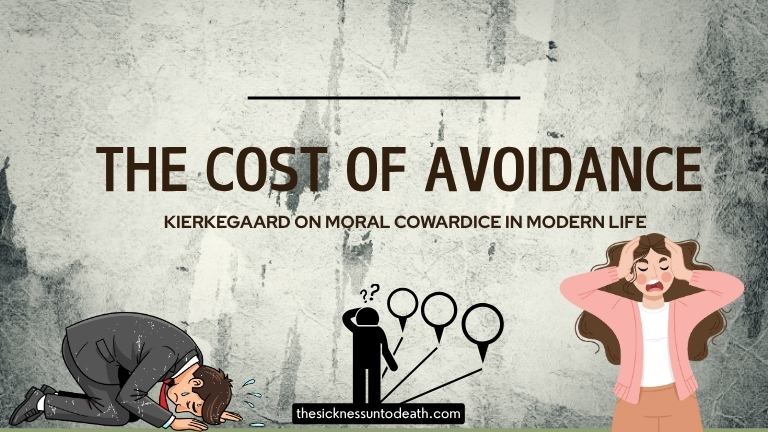
We don’t always make bad decisions.
Sometimes, we simply make no decision at all.
We stay quiet. Stay safe. Delay. Deflect. Distract ourselves. We tell ourselves, “Now’s not the time,” or “Someone else will deal with it.”
And on the surface, everything seems fine.
But deep down, something begins to erode.
Søren Kierkegaard, the Danish philosopher and theologian, believed this kind of avoidance is one of the greatest moral dangers of modern life. Not because we’ve chosen evil, but because we’ve refused to choose at all.
Moral Cowardice Doesn’t Always Look Like Fear
We often imagine cowardice as panic or obvious weakness. But in Kierkegaard’s view, moral cowardice is more subtle—and far more common.
It looks like:
- Avoiding difficult conversations
- Letting injustice slide because it’s uncomfortable to confront
- Hiding behind busyness or irony to avoid deeper responsibility
- Living without commitment, always keeping our options open
This kind of inaction, Kierkegaard argued, leads to a spiritual deadness—a life where we may avoid failure, but never become who we’re meant to be.
“The most common form of despair is not being who you are.”
Why Avoidance Costs More Than We Think
We often avoid decisions to protect ourselves—from conflict, discomfort, risk, or emotional exposure. But what we don’t realise is that avoidance is itself a decision. A decision to stay stagnant. A decision to reject growth. A decision that slowly shapes us—often in ways we don’t intend.
In doing nothing, we become complicit.
In delaying, we drift further from our true values.
In staying silent, we lose the chance to speak with integrity.
Over time, this leads to regret, disconnection, and quiet despair—what Kierkegaard called the sickness unto death.
Courage in the Face of Everyday Choices
Kierkegaard didn’t demand heroic acts. He simply urged people to live with inward honesty and spiritual courage.
That means:
- Saying the thing that needs to be said—even if your voice shakes
- Taking responsibility when it’s easier to pass the blame
- Choosing commitment when comfort would be simpler
- Facing your fears—not to conquer them, but to stop being ruled by them
This is what moral courage looks like in everyday life. It’s not grand. But it is transformational.
Final Thoughts: Choosing to Live, Not Just Exist
Avoidance might feel easier—but it comes at the cost of your soul.
It keeps you safe—but also small.
It protects your ego—but prevents your growth.
Kierkegaard’s challenge is simple, but radical: stop avoiding. Start choosing.
Because every choice—every moment of honesty, integrity, and faith—shapes who you’re becoming.
You don’t need to have all the answers.
You just need to stop hiding from the questions.
Go Deeper
📖 Visit www.thesicknessuntodeath.com
Explore a modern, accessible translation of The Sickness Unto Death, Kierkegaard’s brilliant work on despair, identity, and the inner life.
If you’re tired of drifting or delaying, this is your invitation to begin again.
With courage.
With faith.
With a decision to live more fully—today.