
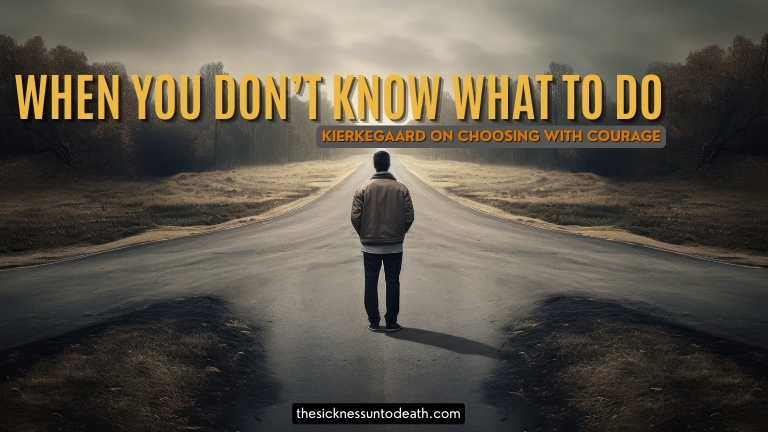
Sometimes the hardest part isn’t doing the right thing. It’s knowing what the right thing even is.
We’ve all been there — stuck in that foggy, paralysing place between options. You turn a decision over and over in your head. You weigh the pros and cons. You ask friends. You pray. You wait for clarity. And still… nothing.
The fear of making the wrong choice can be overwhelming. So instead, we stall. We stay in limbo, hoping certainty will arrive like a sign in the sky.
But Søren Kierkegaard, the Danish philosopher who wrote The Sickness Unto Death, had a surprisingly liberating perspective: you don’t always need clarity to act — but you do need courage.
Paralysis by Overthinking
Modern life doesn’t make choosing any easier. With endless information, conflicting advice, and pressure to “get it right,” it’s no wonder so many of us feel stuck.
Kierkegaard understood this paralysis well. He saw it not just as indecision, but as a symptom of something deeper — a disconnect from the self.
According to him, the most important choices in life can’t be decided with logic alone. They require inwardness — an honest reckoning with your values, your conscience, and your relationship with the eternal.
Choosing Without a Map
Kierkegaard’s writing often emphasises the difficulty of real decisions — not because the options are unclear, but because the self is at stake.
When you make a true choice — not just a preference, but a commitment — you reveal who you are. And that’s scary. Because it requires risk. Vulnerability. Faith.
“To dare is to lose one’s footing momentarily. Not to dare is to lose oneself.”
— Søren Kierkegaard
Sometimes, the only way forward is through the fog. Not because you know exactly where you’re going — but because remaining still would be worse.
The Myth of the Perfect Choice
One of the traps we fall into is the belief that there’s a perfect decision just waiting to be uncovered — and if we just think hard enough, we’ll find it.
But Kierkegaard would argue: the more important the choice, the less likely it is to come with guarantees.
It’s not about picking the “right” path in some objective sense. It’s about choosing with your whole self — and being willing to bear the weight of that decision, come what may.
Faith Doesn’t Erase Uncertainty — It Moves Through It
Kierkegaard isn’t encouraging reckless choices. He’s inviting us to stop waiting for perfect certainty. To stop outsourcing our decisions to others. To stop hiding behind the illusion of neutrality.
Faith, for him, is the courage to act even when you’re afraid. Even when you’re not 100% sure. Because some things — love, vocation, truth — only become clear once you’ve stepped into them.
Don’t Wait to Feel Brave
Courage doesn’t always feel like a roar. Often, it feels like a trembling whisper: “I don’t know how this will go… but I’ll choose anyway.”
Kierkegaard believed that this kind of choosing is sacred — not because it’s flashy or dramatic, but because it calls you into deeper relationship with your own becoming.
You don’t need all the answers.
You just need to show up — inwardly, honestly, faithfully.
💡 If you’re wrestling with doubt, direction, or fear of choosing wrongly, Kierkegaard’s
👉 The Sickness Unto Death: A Modern Translation for the 21st Century
offers deep wisdom for the anxious heart. It’s not a map — but it is a companion for the road.