
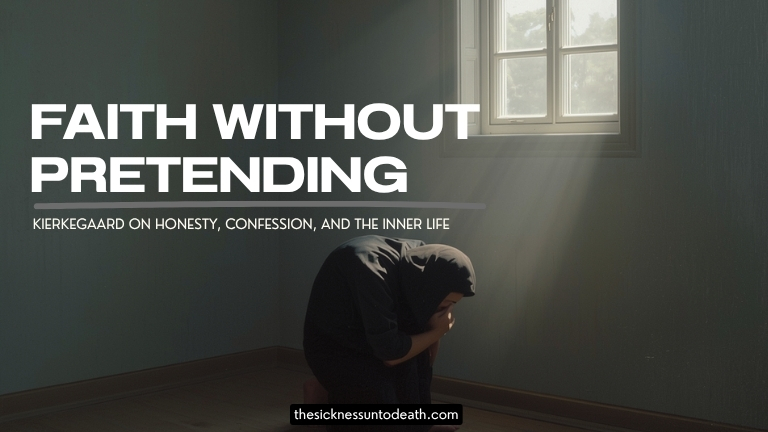
What if real faith begins the moment you stop pretending?
It’s surprisingly easy to look like you have faith.
You say the right words.
You show up when expected.
You keep things respectable, composed, and under control.
From the outside, everything seems steady. But inwardly, it can feel very different — doubts you don’t voice, struggles you keep hidden, questions you quietly push aside.
Søren Kierkegaard believed that this gap between the outer life and the inner life is where something important is at stake. Not just belief, but truthfulness.
Because for him, faith was never about appearances. It was about honesty.
The Danger of Pretending
Kierkegaard was deeply critical of what he saw as “comfortable religion” — a version of faith that blends in, avoids discomfort, and keeps everything tidy.
The problem isn’t that people are insincere on purpose. It’s that over time, we learn to perform. To say what sounds right. To suppress what feels uncertain. To present a version of ourselves that fits.
But this creates a quiet division within the self.
Outwardly, everything appears faithful.
Inwardly, something feels unresolved.
Kierkegaard would say: this is where despair begins — not because you don’t believe enough, but because you’re no longer being fully honest.
Honesty as the Starting Point
For Kierkegaard, faith doesn’t begin with certainty. It begins with truthfulness.
That means acknowledging doubt instead of hiding it. Naming fear instead of ignoring it. Admitting when you don’t feel what you think you’re supposed to feel.
It’s not about having perfect belief. It’s about refusing to live a divided life.
In that sense, honesty is not a threat to faith — it’s the foundation of it.
Confession and the Inner Life
Kierkegaard placed great importance on the inner life — the quiet space where we face ourselves without distraction.
Confession, in this context, isn’t just a religious ritual. It’s a form of inward clarity. A willingness to confront what is real within us, rather than covering it over.
This kind of honesty can feel uncomfortable. It strips away the roles we’ve learned to play. It leaves us without easy answers.
But it also creates space for something deeper — a faith that isn’t based on performance, but on reality.
From Appearance to Authenticity
When we stop pretending, something shifts.
We move from trying to look faithful to actually engaging with faith.
From managing impressions to facing the truth.
From outward conformity to inward integrity.
Kierkegaard didn’t call people to be impressive. He called them to be real.
And that kind of realness isn’t loud or dramatic. It’s quiet, steady, and often hidden — but it’s also where genuine transformation begins.
A Faith That Can Breathe
Pretence makes faith rigid. It has to be maintained, protected, upheld.
Honesty, on the other hand, allows faith to breathe.
It makes room for growth. For questions. For struggle. It acknowledges that becoming a self is not a straight line, but a process.
And perhaps most importantly, it frees us from the exhausting task of trying to be someone we’re not.
Living Without the Mask
You don’t need to have everything figured out.
You don’t need to feel certain all the time.
You don’t need to present a polished version of your inner life.
What Kierkegaard invites us into is something much simpler — and much harder:
To live honestly.
To face ourselves as we are.
To let faith grow from truth, not performance.
💡 If you’re tired of pretending or feeling the tension between what you show and what you really experience, Kierkegaard’s
👉 The Sickness Unto Death: A Modern Translation for the 21st Century
offers a deeply honest exploration of the self, despair, and the path toward authentic faith.