
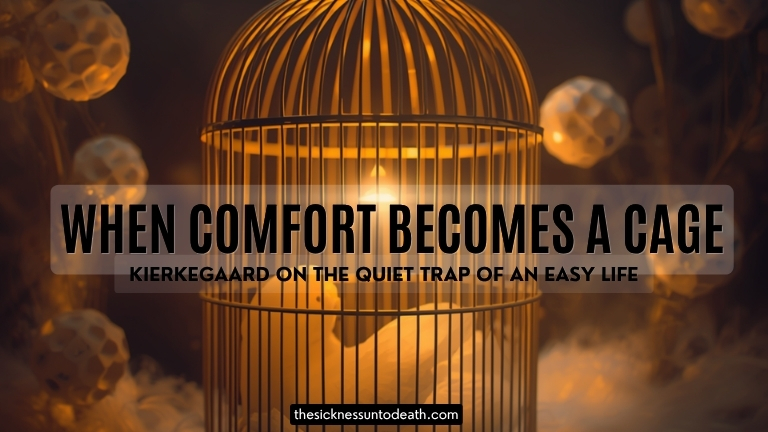
Not all prisons feel restrictive. Some feel… comfortable.
There’s a version of life many people quietly aim for. Stable income. Predictable routine. Minimal stress. Enough comfort to keep things smooth.
And on paper, it makes sense. Who wouldn’t want a life that feels safe and manageable?
But what if that same comfort slowly becomes a kind of cage?
Not one you can see. Not one that anyone else notices. But one you feel — in the form of restlessness, boredom, or a faint sense that you’re not really living, just maintaining.
Søren Kierkegaard saw this long before modern life made comfort so accessible. In The Sickness Unto Death, he describes a form of despair that doesn’t come from suffering, but from avoiding it. From choosing ease over growth, stability over becoming.
The Illusion of “Nothing’s Wrong”
One of the most dangerous states, Kierkegaard suggests, is when everything seems fine.
You’re not in crisis.
You’re not failing.
You’re not struggling in any obvious way.
And yet — something feels flat.
This is what makes the trap so subtle. When nothing is visibly wrong, it’s easy to assume nothing needs to change. But inwardly, the self can begin to stagnate.
Comfort can quietly replace purpose.
When Ease Replaces Growth
An easy life isn’t necessarily a bad life. The problem is when ease becomes the goal rather than a by-product.
Kierkegaard believed that becoming a true self involves tension — facing difficult choices, taking responsibility, stepping into uncertainty. It requires movement, not just maintenance.
But comfort tempts us to avoid all of that.
We stay where things are familiar.
We avoid risks that might stretch us.
We choose what feels safe, even if it feels empty.
Over time, this avoidance doesn’t protect us. It limits us.
The Quiet Form of Despair
In The Sickness Unto Death, Kierkegaard describes despair not just as emotional pain, but as a misalignment within the self.
And one of its quietest forms is this: living a life that never fully engages with who you could become.
It doesn’t look dramatic. It doesn’t draw attention. But it slowly narrows your world.
You stop asking deeper questions.
You stop challenging yourself.
You settle.
And in settling, something essential is left untouched.
The Risk of Staying Comfortable
The longer we stay in comfort, the harder it becomes to leave.
Not because we can’t — but because we no longer want to. The unfamiliar starts to feel threatening. Growth feels inconvenient. Change feels unnecessary.
Kierkegaard would say this is where the real danger lies. Not in hardship, but in refusing to move beyond what is easy.
Because becoming yourself will always require some form of discomfort.
Choosing Growth Over Ease
This doesn’t mean rejecting comfort altogether. It means refusing to let it define your life.
It means asking:
- Where have I chosen ease over honesty?
- Where am I avoiding growth because it feels uncomfortable?
- What part of myself have I left undeveloped?
These are not easy questions. But they are necessary ones.
Because the goal isn’t to make life harder — it’s to make it truer.
A Life That Feels Alive
Kierkegaard’s challenge is simple, but demanding: don’t let your life shrink into comfort.
Choose engagement over avoidance.
Choose growth over ease.
Choose becoming over settling.
Because a life that feels safe on the outside can still feel empty on the inside. But a life that stretches you — that calls something out of you — begins to feel alive again.
💡 If you’ve ever felt stuck in a life that looks fine but feels limiting, Kierkegaard’s
👉 The Sickness Unto Death: A Modern Translation for the 21st Century
offers a powerful and accessible exploration of the self, despair, and what it means to truly become who you are meant to be.