
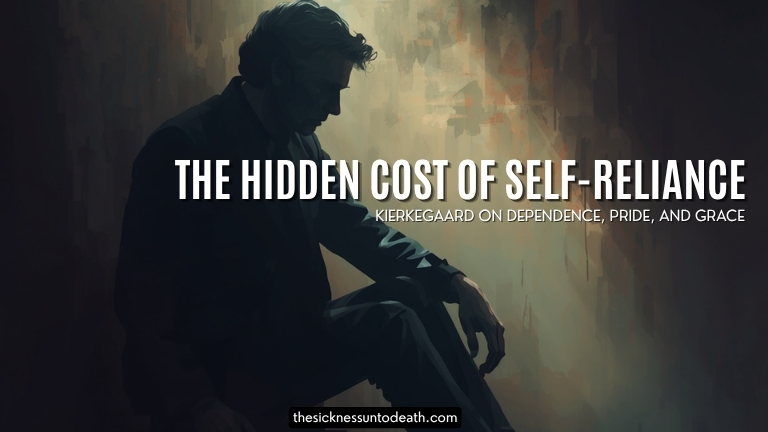
We admire self-reliance.
From an early age, we’re taught to be independent, capable, and strong. “Don’t depend on anyone.” “Handle it yourself.” “Keep going.” In many ways, self-reliance has become a modern virtue — proof that you’re competent and in control.
And to a point, independence matters. Responsibility matters. Maturity matters.
But Søren Kierkegaard believed there is a hidden danger when self-reliance becomes absolute. In The Sickness Unto Death, he explores how the self can slowly become trapped in the illusion that it must sustain itself entirely on its own.
The result isn’t freedom.
It’s exhaustion.
The Pressure to Be Your Own Foundation
Modern life quietly pushes us towards self-sufficiency. We’re expected to build ourselves, improve ourselves, heal ourselves, motivate ourselves, and carry ourselves through every crisis.
Outwardly, this can look impressive. Internally, it often creates enormous pressure.
Because eventually, every person reaches a limit.
You can manage your schedule.
You can discipline your habits.
You can project confidence.
But there are moments when the deeper questions still break through:
- What happens when I can’t hold everything together?
- What if strength alone isn’t enough?
- Who am I when I stop performing competence?
Kierkegaard believed these moments are deeply important — because they expose the fragile foundation beneath excessive self-reliance.
Pride Doesn’t Always Look Arrogant
When people hear the word pride, they often imagine arrogance or superiority. But Kierkegaard understood pride in a much subtler way.
Sometimes pride looks like refusing help.
Refusing vulnerability.
Refusing to admit weakness.
It’s the belief that we must carry ourselves alone. That dependence is failure. That needing support somehow diminishes us.
But the more tightly we cling to this idea, the more isolated the self becomes.
The Self Cannot Sustain Itself Forever
In The Sickness Unto Death, Kierkegaard argues that despair emerges when the self becomes disconnected from what truly grounds it.
One form of despair is the desperate attempt to be completely self-sufficient — to rely entirely on your own strength, identity, and control.
At first, this can feel empowering. But over time, it becomes heavy. The self was never meant to bear the full weight of existence alone.
Eventually, cracks appear:
- burnout
- anxiety
- emotional numbness
- quiet hopelessness
Not because the person is weak, but because endless self-reliance is unsustainable.
Why Dependence Feels So Difficult
Many of us resist dependence because it feels unsafe. Vulnerability exposes us. It forces us to acknowledge that we are limited, imperfect, and unable to control everything.
Kierkegaard believed this resistance is deeply tied to the human condition. We want autonomy without limitation. Strength without weakness. Confidence without uncertainty.
But becoming a whole self requires accepting reality — including our dependence.
That acceptance is not humiliation. It’s honesty.
Grace Begins Where Pretence Ends
One of Kierkegaard’s deepest insights is that healing begins when we stop pretending to be invulnerable.
Grace becomes possible when the performance of self-sufficiency finally cracks open.
Not because weakness is admirable in itself, but because truth creates space for something deeper than pride ever can.
A person who never admits need can never fully receive care, connection, or grace.
A Different Kind of Strength
Kierkegaard’s vision of maturity is not about becoming untouchable. It’s about becoming truthful.
Strong enough to admit limits.
Honest enough to ask for help.
Grounded enough to stop building identity around endless performance.
That kind of life may appear less impressive on the surface. But inwardly, it is far more stable.
Because real strength does not come from pretending you need nothing.
It comes from no longer being afraid of dependence.
Letting Go of the Burden
You do not have to carry your entire existence alone.
You do not have to prove your worth through constant competence.
You do not have to build a flawless self to deserve peace.
Sometimes the most important step forward is not trying harder — but letting go of the exhausting belief that everything depends entirely on you.
💡 If you’ve ever felt worn down by the pressure to keep holding everything together, Kierkegaard’s
👉 The Sickness Unto Death: A Modern Translation for the 21st Century
offers a powerful exploration of the self, despair, vulnerability, and the path towards a more honest and grounded life.