
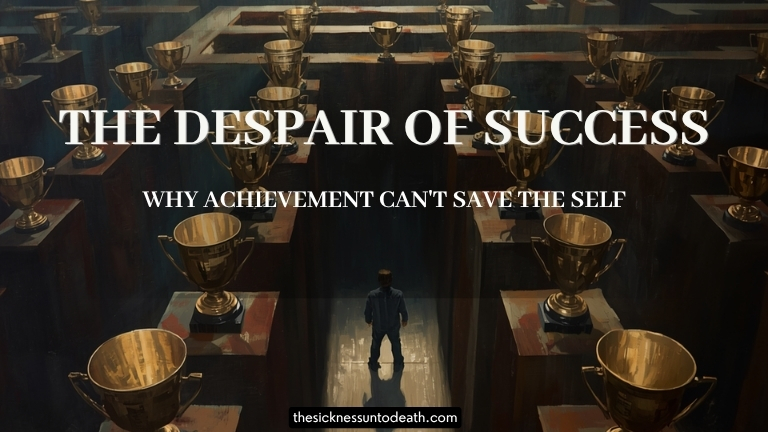
You got the promotion. You bought the house. You reached the goal you’ve been chasing for years.
So why does something still feel missing?
Many people assume success will eventually deliver fulfilment. We imagine that once we achieve enough, earn enough, or become enough, a deep sense of satisfaction will naturally follow. Yet countless successful people discover an uncomfortable truth: achievement can solve many problems, but it cannot answer the question of who we are.
This is precisely the issue Søren Kierkegaard explored in The Sickness Unto Death. Long before social media, personal branding, and hustle culture, he recognised that a person could appear successful by every external measure while remaining inwardly lost.
The Success Story That Doesn't Feel Complete
Modern culture teaches us to measure life through accomplishments.
We celebrate promotions, qualifications, business growth, financial milestones, and public recognition. None of these things is inherently bad. In fact, they can be meaningful expressions of talent, responsibility, and service.
The problem begins when achievement becomes the foundation of identity.
When our sense of self depends on success, every accomplishment carries an impossible burden. We are no longer simply pursuing goals; we are asking those goals to tell us who we are.
And they can’t.
The promotion may bring excitement for a few weeks. The new salary may provide security. The praise may feel rewarding. But eventually the question returns:
“Is this all there is?”
Kierkegaard's Diagnosis: Despair Hidden Behind Success
In The Sickness Unto Death, Kierkegaard argues that despair is not simply sadness or depression. Despair is a deeper spiritual condition. It emerges when the self is not properly related to itself and to God.
What makes despair particularly dangerous is that it often goes unnoticed.
A person can be productive, admired, financially secure, and socially respected while living in despair. Outwardly, everything appears healthy. Inwardly, something essential is disconnected.
Kierkegaard believed that one form of despair involves building a self entirely around worldly achievements. The individual becomes absorbed in status, reputation, influence, or accomplishment while neglecting the deeper question of what it means to be a self before God.
From the outside, this may look like success.
From the inside, it can feel strangely empty.
Why Achievement Never Feels Like Enough
Have you ever noticed how quickly a major achievement becomes normal?
The goal that once consumed your thoughts soon fades into the background. The satisfaction doesn’t disappear entirely, but it rarely lasts as long as expected.
Psychologists call this hedonic adaptation. Kierkegaard might describe it differently. He would suggest that no finite accomplishment can satisfy an infinite longing.
Human beings are not merely economic creatures seeking comfort or recognition. We are spiritual beings wrestling with questions of meaning, purpose, identity, and eternity.
That is why achievement often creates a paradox.
The more successful we become, the more obvious it becomes that success itself cannot provide ultimate meaning.
The ladder we’ve spent years climbing suddenly reveals itself to be leaning against the wrong wall.
The Modern Cult of Achievement
Today’s culture intensifies this problem.
Social media constantly presents curated images of success. We are encouraged to optimise every area of life, build personal brands, maximise productivity, and chase ever-larger goals.
Success becomes not merely something we pursue but something we perform.
The result is a subtle form of exhaustion.
Many people spend years constructing an impressive life only to discover they have neglected their inner life. Their calendar is full, but their soul feels empty. Their career is thriving, but their sense of self feels fragile.
Kierkegaard saw this danger long before the digital age. He warned that becoming absorbed in external measures of worth can distract us from the deeper task of becoming ourselves.
Becoming a Self Rather Than Building an Image
According to Kierkegaard, the central challenge of life is not achieving success but becoming a true self.
That sounds simple until we realise how often we define ourselves through external things:
- Career titles
- Social status
- Wealth
- Academic accomplishments
- Public approval
- Professional recognition
These things can describe aspects of our lives, but they cannot constitute our deepest identity.
A career can end.
Money can disappear.
Public opinion can change overnight.
If our self rests entirely on these foundations, we remain vulnerable to despair because the foundations themselves are unstable.
True selfhood requires something deeper.
Success as a Gift, Not a Saviour
Kierkegaard does not suggest that achievement is bad.
The issue is not success itself but the role we assign to it.
Success becomes destructive when we expect it to save us.
Achievements can be gifts. They can provide opportunities to serve others, develop our talents, and contribute meaningfully to society. But they were never designed to answer the deepest questions of existence.
No promotion can tell you why you exist.
No award can establish your eternal worth.
No amount of recognition can remove the human need for meaning, purpose, and relationship with God.
The moment we stop asking achievement to be our saviour, we are free to appreciate it for what it is.
The Way Beyond the Despair of Success
The cure for the despair of success is not failure.
Nor is it abandoning ambition altogether.
The answer lies in reordering our priorities.
Kierkegaard invites us to shift our focus from external accomplishments to inward formation. Rather than asking, “What have I achieved?” we begin asking, “Who am I becoming?”
That question changes everything.
It redirects attention from image to character, from performance to authenticity, from public approval to spiritual integrity.
It reminds us that the most important work in life is not building a résumé but becoming a self.
Final Thoughts
Success can improve your circumstances, but it cannot resolve the deepest questions of the human heart.
That is why some of the most accomplished people in history have still wrestled with emptiness, anxiety, and despair.
Kierkegaard’s insight remains remarkably relevant today. External achievements are valuable, but they cannot provide the foundation of identity. The self requires something more enduring than success.
It requires a relationship with the source from which the self ultimately comes.
If you’ve ever reached a goal only to wonder why satisfaction faded so quickly, you’re not alone. Kierkegaard understood that experience well. The question is not whether achievement matters. The question is whether we’ve asked achievement to do something it was never meant to do.
And perhaps that realisation is the beginning of genuine freedom.
Further Reading
For readers interested in exploring Kierkegaard’s profound analysis of despair, selfhood, and faith in accessible modern language, check out The Sickness Unto Death: A Modern Translation for the 21st Century at www.thesicknessuntodeath.com.