
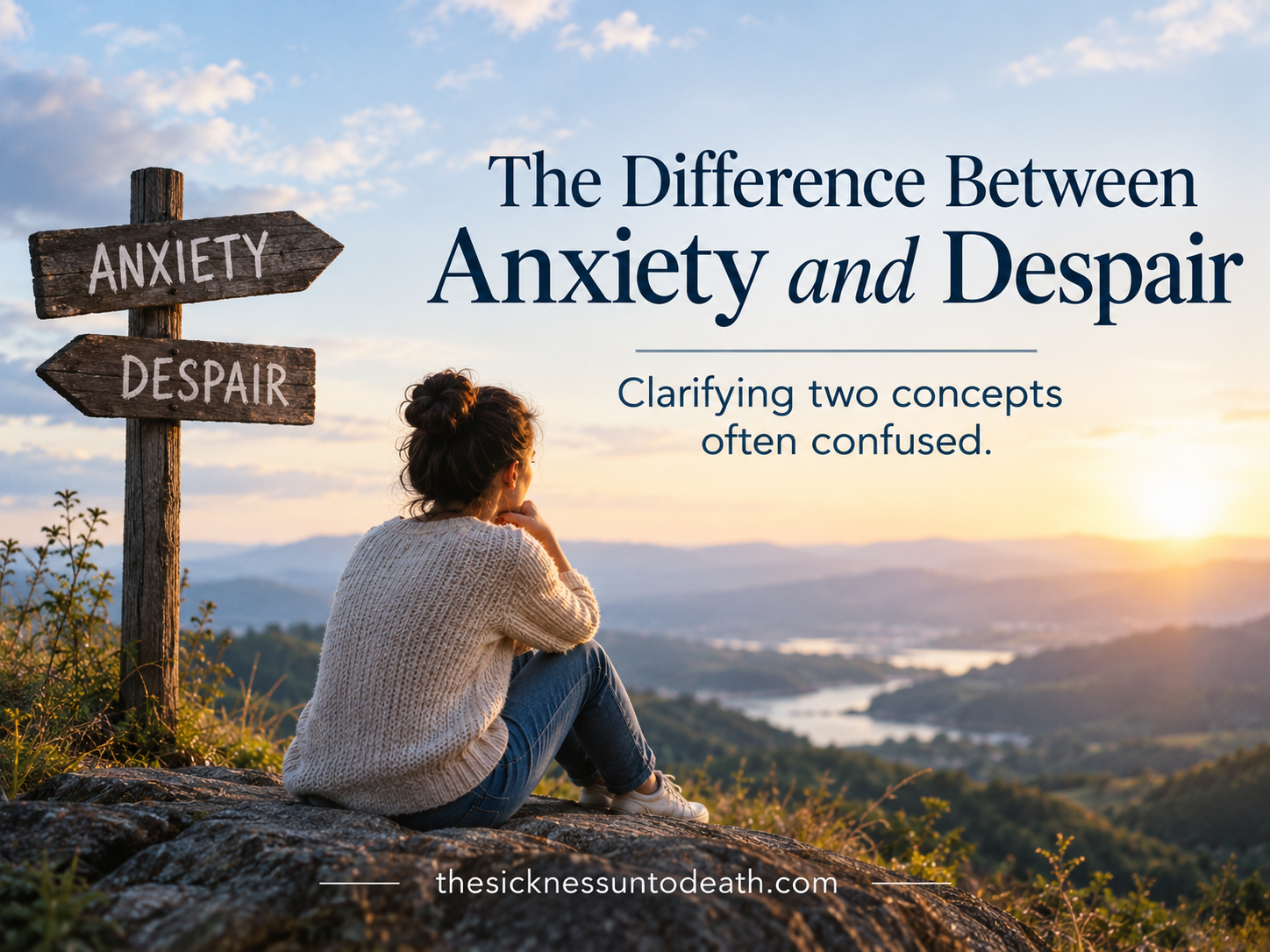
We all know what it feels like to be unsettled. Perhaps you are worrying about the future, lying awake at night thinking about a difficult decision, or feeling that something in your life simply is not right. These experiences are often described as anxiety, but sometimes the discomfort runs deeper than worry alone.
This is where the distinction between anxiety and despair becomes important.
Although the two experiences can overlap, they are not quite the same. Anxiety is often connected with uncertainty, fear and the possibilities that lie ahead. Despair, particularly in the philosophical sense explored by Søren Kierkegaard, concerns something more fundamental: our relationship with ourselves.
Understanding the difference can help us look beyond the surface of our feelings and ask a more meaningful question: Am I frightened about what might happen to me, or am I struggling with who I am?
Both questions deserve attention, but they point towards different kinds of understanding.
1. What Is Anxiety?
Anxiety is often associated with the anticipation of something uncertain. It can arise when we face a difficult decision, enter an unfamiliar situation or become aware of the many things that could go wrong.
You might feel anxious before a job interview, when waiting for important news or when considering a major change in your life. Even when there is no immediate danger, the mind can become occupied with possible outcomes.
Questions begin to multiply:
- What if I make the wrong decision?
- What if I disappoint someone?
- What if things do not work out as I hoped?
- What if I am not prepared for what comes next?
Anxiety can make the future feel overwhelming. It draws our attention towards what has not yet happened, encouraging us to imagine different possibilities and attempt to prepare for them.
Yet anxiety is not necessarily a sign that something is wrong with us. It can also arise because we recognise that life involves choices, uncertainty and responsibility.
Kierkegaard's understanding of anxiety
In The Concept of Anxiety, Søren Kierkegaard explores anxiety as something closely connected with human freedom and possibility.
His understanding goes beyond ordinary nervousness. Anxiety can emerge when we become aware that we are free to choose, that our decisions matter and that the future is not entirely determined.
Freedom can be exciting, but it can also be frightening. We may long for new possibilities while simultaneously wishing we could avoid the uncertainty they bring.
Think about standing at a crossroads in life. One path offers familiarity, while another presents the possibility of change. You may feel drawn towards the unfamiliar path, yet hesitate because you cannot know exactly where it will lead.
For Kierkegaard, this tension helps explain the distinctive character of anxiety. It is connected with the possibilities of existence and the responsibility that comes with freedom.
2. What Is Despair?
Despair is often understood as profound sadness, hopelessness or the feeling that there is no way forward. These are familiar experiences of despair in everyday language.
However, Kierkegaard gives the concept a deeper philosophical meaning in The Sickness Unto Death.
For him, despair is fundamentally connected with the self. It concerns the way a person relates to who they are, who they might become and the deeper foundations of their existence.
This means that despair is not always obvious.
A person might appear successful, confident and perfectly comfortable with their life while privately feeling disconnected from themselves. Another person might be deeply dissatisfied with who they are, wishing they could become someone entirely different.
In Kierkegaard’s account, both situations can reveal different forms of despair.
The central issue is not simply whether someone feels unhappy. It is whether the person is struggling with the task of being themselves.
The self and the experience of despair
Kierkegaard understands the human self as a relationship involving different dimensions of existence, including the finite and infinite, necessity and possibility.
In simpler terms, we are shaped by the realities of our lives, but we are also beings who imagine, choose, hope and become.
Despair can emerge when this relationship becomes distorted. We might become so absorbed in external expectations that we lose sight of ourselves. Alternatively, we might become so determined to control our own identity that we refuse to acknowledge our limitations or dependence on something beyond ourselves.
In The Sickness Unto Death, despair is therefore not merely a passing emotion. It is a deeper problem concerning the relationship between the self and itself.
3. Anxiety vs Despair: Understanding the Difference
Although anxiety and despair can occur together, they direct our attention towards different aspects of human existence.
Anxiety
Concern with possibility and uncertainty
Anxiety often involves the fear, anticipation or unease associated with what might happen. It can arise when we recognise that we have choices but cannot fully control their outcomes.
Despair
Concern with the self and its relationship to itself
In Kierkegaard’s philosophical account, despair involves a struggle with being oneself. It can appear as a refusal to accept who we are or as an unwillingness to become the self we are called to be.
The distinction can be expressed through two questions:
- Anxiety asks: What might happen, and how should I respond to the possibilities before me?
- Despair asks: How am I relating to myself, and am I willing to be the person I am?
These questions are connected, but they are not interchangeable. Kierkegaard’s writings treat anxiety and despair as related yet distinct concepts, with anxiety connected to freedom and possibility, and despair connected to the self.
4. Why Anxiety and Despair Are So Easily Confused
It is understandable that people confuse anxiety and despair. Both can involve inner turmoil, uncertainty and a sense of being unable to move forward.
When someone is anxious, they might struggle to make decisions, withdraw from opportunities or become preoccupied with everything that could go wrong. When someone experiences despair, they might also feel stuck, disconnected or unable to imagine a meaningful future.
From the outside, these experiences can look remarkably similar.
Consider someone who feels trapped in a job they no longer enjoy.
At first, their anxiety might centre on the uncertainty of leaving. They worry about money, disappointing their family or failing in a new career. Their attention is focused on what could happen if they make a change.
But there may be another struggle beneath these concerns.
Perhaps they have spent years building a life around other people’s expectations. Perhaps they have become so accustomed to playing a particular role that they no longer know what they genuinely want.
The anxiety concerns the risks of changing their circumstances. The deeper despair, in Kierkegaard’s sense, concerns the relationship they have developed with themselves.
Of course, one does not automatically prove the existence of the other. Not every anxious person is experiencing despair, and not everyone who feels disconnected from themselves experiences clinical anxiety.
The distinction is philosophical rather than a substitute for psychological assessment.
5. Can Anxiety Lead to Despair?
Kierkegaard’s account allows us to explore how anxiety and despair may become connected.
When we become aware of our freedom, we also become aware of the responsibility involved in choosing. We realise that our lives are not simply something that happens to us. We participate in shaping them.
That awareness can be uncomfortable.
Sometimes, rather than confronting the possibilities before us, we try to escape them. We might avoid making decisions, follow familiar routines or allow other people to determine the direction of our lives.
These responses may offer temporary relief. If we never choose, perhaps we can avoid the possibility of choosing wrongly.
But avoiding every difficult choice can also mean avoiding the task of becoming ourselves.
In Kierkegaard’s philosophical framework, anxiety can therefore be connected with despair when the individual fails to relate to freedom and possibility in a way that supports the development of the self. Anxiety itself, however, is not despair, nor does it inevitably lead to it.
This is an important distinction. The goal is not to treat every uncomfortable feeling as evidence of a deeper existential problem. Rather, it is to recognise that uncertainty can sometimes invite us to examine how we are living.
6. Recognising the Difference in Everyday Life
It can be helpful to consider what is happening beneath the immediate feeling.
Here are a few examples of how anxiety and despair might appear in ordinary situations.
Example 1: Fear of failure
Someone is offered a promotion but feels anxious about accepting it. They worry about making mistakes, handling extra responsibility and disappointing their colleagues.
Anxiety: The uncertainty surrounding a new responsibility and its possible consequences.
Example 2: Living to please others
Someone has built a life around meeting other people’s expectations. They appear content, yet privately feel that they have lost touch with their own values and desires.
Despair: In Kierkegaard’s sense, the struggle may concern a reluctance to become oneself rather than simply a fear of what might happen.
Example 3: Feeling unable to change
Someone knows that their current way of living no longer feels right, but they are frightened of what change might demand. They repeatedly postpone decisions and become increasingly dissatisfied.
Anxiety and despair together: Fear of the unknown may exist alongside a deeper struggle about how to live as oneself.
These examples are illustrations, not diagnoses. A person’s experience may involve several emotions and circumstances at once. The point is to distinguish the object of their immediate concern from the deeper questions about identity and selfhood that may also be present.
7. Moving Beyond Anxiety and Despair
Understanding the difference between anxiety and despair does not mean that we can simply think our way out of either experience.
Anxiety can be difficult to manage, particularly when it becomes persistent or begins to interfere with everyday life. Practical support, healthy routines, talking with someone we trust and professional help when needed can all have an important role.
Despair, as Kierkegaard understands it, invites a different kind of reflection.
Instead of asking only how to remove discomfort, we might also ask how we are relating to ourselves.
Are we living according to values we genuinely believe in, or are we simply trying to satisfy everyone around us?
Are we refusing to acknowledge our limitations, or have we become so focused on them that we can no longer imagine any possibility for change?
Are we willing to take responsibility for becoming ourselves, even when doing so involves uncertainty?
These questions are not invitations to blame ourselves for struggling. They are opportunities to approach our lives with greater honesty.
For Kierkegaard, the movement away from despair involves becoming the self one truly is. Within his Christian framework, this also involves understanding the self in relation to the power that established it.
That is a more demanding task than simply trying to feel better. It asks us to consider not only what we want from life, but how we understand ourselves and what it means to live truthfully.
A note on mental health
Anxiety and despair are philosophical concepts in this discussion, not medical diagnoses. Persistent anxiety, hopelessness or emotional distress can also have psychological or medical dimensions. If these feelings are affecting your daily life, consider speaking with a qualified mental health professional. Philosophical reflection can complement appropriate support, but it does not replace it.
8. What The Sickness Unto Death Can Teach Us About the Self
Kierkegaard’s The Sickness Unto Death remains a challenging and thought-provoking exploration of what it means to be human.
Rather than treating despair simply as sadness or unhappiness, it asks us to examine the relationship we have with ourselves. It explores the ways we might avoid our own identity, become absorbed in external expectations or struggle with the responsibility of being a self.
Read alongside The Concept of Anxiety, these ideas offer a way of thinking about two experiences that are often confused.
Anxiety draws our attention towards freedom, uncertainty and possibility. Despair turns our attention towards the self and the difficulty of becoming who we are.
Neither concept should be reduced to a simple formula. Human experience is complicated, and the same person may encounter anxiety, despair, grief, uncertainty and hope at different points in life.
But learning to distinguish between them can give us a more precise language for understanding our inner lives.
And sometimes, finding the right question is the beginning of a deeper understanding.
Explore The Sickness Unto Death: A Modern Translation for the 21st Century
If you would like to explore Kierkegaard’s ideas about despair, selfhood and the challenge of becoming yourself, discover The Sickness Unto Death: A Modern Translation for the 21st Century.
Visit the website to learn more about the book and its exploration of one of philosophy’s most enduring questions: what does it mean to be a self?