
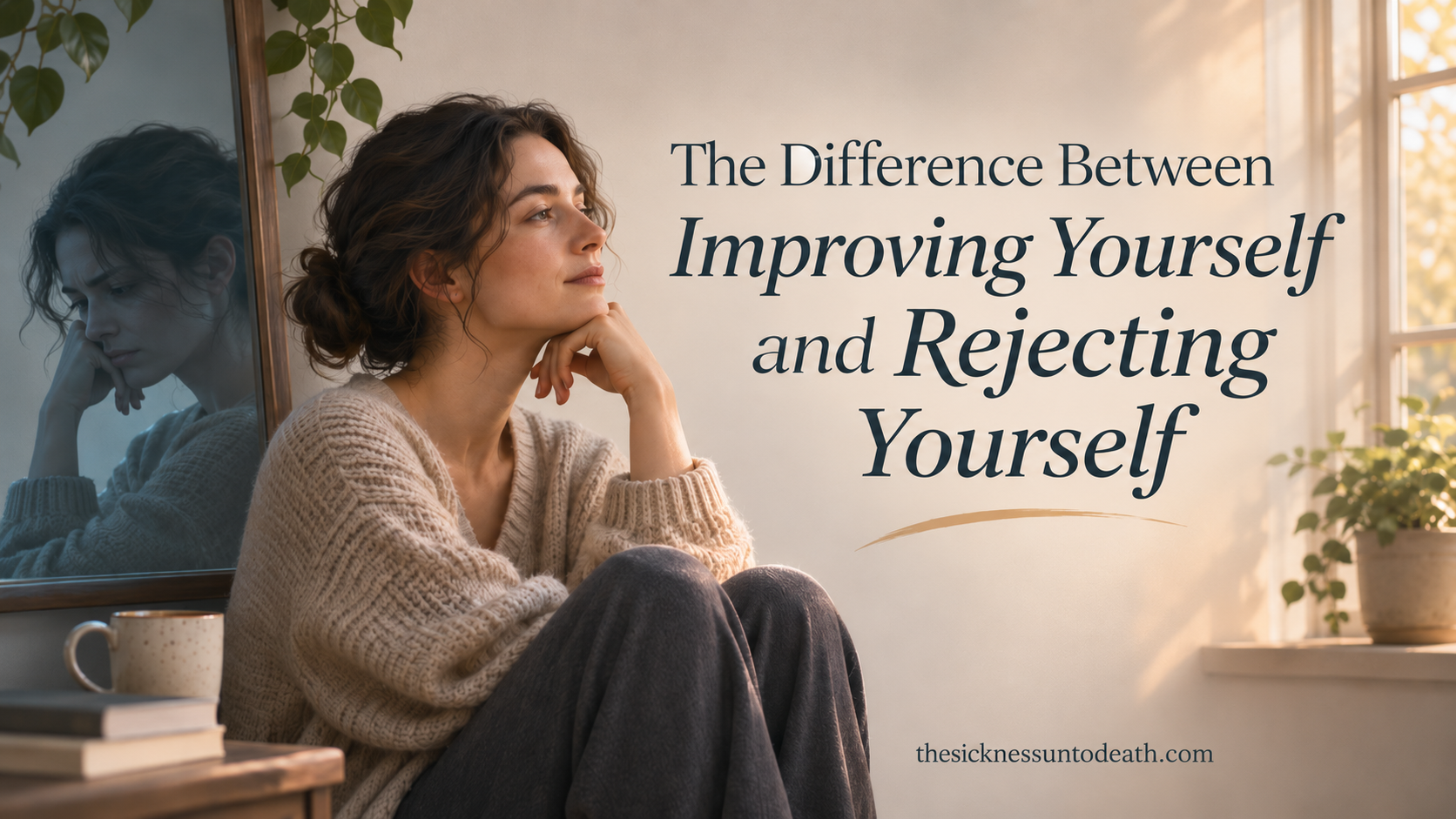
There’s nothing wrong with wanting to become a better version of yourself.
Perhaps you want to be more confident, more patient or more disciplined. Maybe you want to develop healthier habits, improve your relationships or finally make progress towards something you’ve been putting off for years.
Wanting to grow is a natural part of being human.
But there’s a difference between wanting to improve your life and feeling as though the person you are right now isn’t good enough.
And sometimes, that difference is difficult to recognise.
We tell ourselves we’re working towards something better. We set goals, make plans and promise to change.
Yet somewhere along the way, personal growth can become something else entirely.
Instead of learning to appreciate who we are while making improvements, we begin treating ourselves as a problem that needs fixing.
So how can we tell the difference between self-improvement and self-rejection?
When Self-Improvement Comes from a Healthy Place
Healthy self-improvement begins with the understanding that you have value, even when there are things about yourself you’d like to change.
You might recognise that you struggle with procrastination, for example.
Rather than calling yourself lazy or useless, you begin looking at why certain tasks feel difficult. Perhaps you’re overwhelmed, afraid of failing or simply unsure where to begin.
You make small adjustments.
You try different approaches.
Some days go well. Others don’t.
But your progress doesn’t determine whether you’re worthy of respect, kindness or happiness.
That’s what healthy personal growth looks like.
It’s not about becoming a completely different person. It’s about giving yourself the opportunity to develop without constantly criticising who you already are.
You can recognise your weaknesses without making them your entire identity.
And you can want something better for yourself without believing that your current self is somehow unacceptable.
When Personal Growth Becomes Self-Rejection
Self-rejection often disguises itself as ambition.
It sounds like motivation.
It looks like discipline.
It can even produce impressive results.
But underneath the achievements, there may be a quiet belief that you’re never quite enough.
You might catch yourself thinking:
- I’ll be happy when I lose weight.
- I’ll feel successful when I earn more money.
- I’ll finally feel confident when people respect me.
- I’ll be proud of myself when I stop making mistakes.
- I’ll deserve to relax when I’ve achieved everything on my list.
There’s always another condition.
Another milestone.
Another version of yourself you’re trying to reach.
And the difficulty is that even when you achieve something, the satisfaction doesn’t always last.
You accomplish one goal, only to discover that you’ve already created another reason to feel inadequate.
Instead of celebrating how far you’ve come, you focus on everything you still haven’t done.
What began as a desire to improve becomes a constant attempt to escape the person you are.
Why We Sometimes Feel We Need to Become Someone Else
It’s easy to assume that our desire to change comes entirely from within.
But we’re influenced by more than we realise.
From an early age, we absorb messages about what success should look like.
We’re praised for good grades, achievements, appearance, productivity and the ability to meet expectations.
As adults, those expectations often become even more complicated.
Social media shows us people who appear more successful, more confident, healthier or happier.
We see carefully selected moments from other people’s lives and compare them with the ordinary, sometimes messy reality of our own.
Even when we know those comparisons aren’t fair, they can still affect how we see ourselves.
Gradually, we may begin to believe that becoming better means becoming more like someone else.
But there’s an important question worth asking:
Are you changing because something genuinely matters to you, or because you feel you must become someone different to be accepted?
The answer isn’t always straightforward.
Sometimes our goals come from a mixture of personal ambition, social expectations and the desire to belong.
Understanding those influences can help us make choices that feel more authentic.
The Exhaustion of Never Feeling Good Enough
There’s a particular kind of tiredness that comes from constantly trying to improve yourself.
It’s not simply the exhaustion of working hard.
It’s the feeling that you can never truly rest because there’s always something about yourself that needs attention.
You should be reading more.
Exercising more.
Learning something new.
Making better decisions.
Being more productive.
Even your free time can begin to feel like another opportunity for self-improvement.
Instead of enjoying a quiet Sunday afternoon, you feel guilty for not doing something useful.
Instead of appreciating an achievement, you immediately wonder what comes next.
Over time, this can make life feel like an endless assessment of your own performance.
And when every moment becomes an opportunity to measure yourself, it’s difficult to feel content.
Personal development is meant to support your life, not consume it.
Sometimes the healthiest thing you can do is recognise that not every part of your existence needs to be improved.
Some things can simply be enjoyed.
Self-Acceptance Doesn't Mean Giving Up
One of the biggest misunderstandings about self-acceptance is the idea that accepting yourself means refusing to change.
But the two aren’t opposites.
You can accept yourself and still want to grow.
You can acknowledge your limitations while working to overcome them.
You can appreciate your life while recognising that certain things could be different.
Think about someone learning a new skill.
A person who approaches learning with self-acceptance might say, “I’m not very good at this yet, but I’m willing to practise.”
Someone approaching the same situation through self-rejection might think, “I can’t believe I’m so bad at this. I should be better by now.”
Both people recognise that improvement is needed.
But their relationship with that improvement is entirely different.
One sees learning as an opportunity.
The other sees it as evidence of personal failure.
And that difference matters.
When growth comes from self-respect rather than self-criticism, setbacks can become easier to approach with curiosity instead of shame.
You don’t have to dislike yourself to become someone you’re proud of.
Learning to Separate Who You Are from What You Do
We often describe ourselves through our achievements, careers, relationships and responsibilities.
“I’m a successful business owner.”
“I’m a good parent.”
“I’m a hard worker.”
There’s nothing necessarily wrong with these descriptions.
But problems can arise when our entire sense of identity depends on maintaining them.
What happens when the business struggles?
When parenting feels difficult?
When you’re exhausted and can’t be productive?
If your worth depends entirely on what you achieve, even ordinary setbacks can feel like threats to who you are.
This is why developing a healthier relationship with yourself involves learning to separate your identity from your performance.
You are more than your latest achievement.
More than your mistakes.
More than the expectations other people place upon you.
Your actions matter, of course. They shape your experiences and affect those around you.
But they don’t have to become the sole measure of your value as a person.
How to Tell Whether You're Improving or Rejecting Yourself
Sometimes the easiest way to recognise the difference is to pay attention to how you speak to yourself.
Imagine you’ve set a goal and haven’t achieved it.
What happens next?
Do you become curious about what went wrong, or do you immediately start criticising yourself?
Do you adjust your approach, or decide that you’ve failed as a person?
Do you allow yourself to acknowledge progress, or dismiss everything because the outcome wasn’t perfect?
These responses can reveal a great deal about what’s motivating your desire to change.
Here are a few questions worth considering:
- Would I still value myself if I never achieved this goal?
Your answer might reveal how closely your self-worth is connected to a particular outcome.
- Am I pursuing this change because it matters to me?
Or are you trying to satisfy expectations that don’t genuinely reflect your own values?
- How do I treat myself when I make mistakes?
Growth involves setbacks. If every mistake becomes an excuse for harsh self-criticism, the process may be causing more distress than necessary.
- Can I appreciate who I am while recognising where I’d like to improve?
These two feelings can exist together.
- Am I enjoying the process, or simply waiting to become someone I can finally accept?
Perhaps this is the most important question of all.
Because if happiness is always reserved for some future version of yourself, you risk overlooking the life you’re living right now.
Becoming Yourself Rather Than Escaping Yourself
The relationship between personal growth and identity isn’t a new concern.
Philosophers have spent centuries exploring what it means to become ourselves, why we struggle with our identities and how our desire to be different can sometimes create an uncomfortable distance from who we are.
One thinker who explored these questions in remarkable depth was Søren Kierkegaard, the nineteenth-century Danish philosopher.
In his work The Sickness Unto Death, Kierkegaard examines despair, selfhood and the complicated ways human beings relate to themselves.
One of the central concerns of the book is that despair can involve an unwillingness to be oneself, as well as a troubled desire to define oneself entirely on one’s own terms.
It’s a challenging idea, but one that still feels relevant.
How often do we struggle not because our lives are objectively terrible, but because we feel uncomfortable with who we are?
How often do we imagine that happiness will arrive once we’ve transformed ourselves into someone more successful, attractive, confident or accomplished?
Kierkegaard’s exploration invites us to consider whether the answer is always to become someone different, or whether part of the challenge lies in understanding our relationship with ourselves.
For readers interested in these questions, The Sickness Unto Death: A Modern Translation for the 21st Century offers an opportunity to explore Kierkegaard’s ideas in more accessible, contemporary language.
Discover more about identity, despair and what it means to be yourself.
Explore The Sickness Unto Death: A Modern Translation for the 21st Century
A Kinder Way to Approach Personal Growth
Perhaps the most useful change we can make is not abandoning self-improvement, but changing the reason behind it.
Instead of asking, “What’s wrong with me that I need to fix?” we might ask, “What would help me live a healthier, more meaningful life?”
Instead of saying, “I’m not good enough until I succeed,” we might remind ourselves that learning and growing are worthwhile regardless of the outcome.
And instead of treating every weakness as something shameful, we can begin recognising that being human involves uncertainty, mistakes and unfinished progress.
None of this means that change will always be easy.
There will still be difficult days.
There will still be habits to work on, decisions to reconsider and situations that ask more of us than we expected.
But those experiences don’t have to become evidence that we’re inadequate.
They can simply be part of living, learning and becoming.
You Don't Have to Become Someone Else to Be Enough
It’s easy to spend years chasing an imagined version of ourselves.
The person who’s always confident.
Always productive.
Always calm.
Always making the right decisions.
But that person doesn’t really exist.
Everyone has doubts, limitations and moments when life feels uncertain.
The goal of personal growth shouldn’t be to eliminate everything imperfect about ourselves.
It should be to understand ourselves better, make meaningful choices and develop in ways that genuinely enrich our lives.
There is room for ambition and acceptance.
For recognising your strengths and acknowledging your weaknesses.
For appreciating where you are while remaining curious about where you might go.
You can want to become better without believing that who you are today is not enough.
And perhaps that’s where genuine self-improvement begins.
Not with the desire to escape yourself, but with the willingness to understand yourself.