
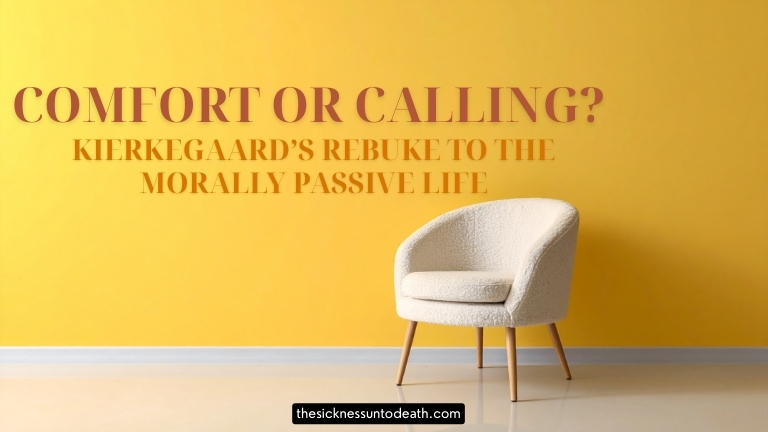
Doing nothing isn’t neutral — it’s a choice with consequences.
There’s a quiet kind of life many people settle into. It’s not destructive or malicious. It’s respectable, steady, “normal.” You go to work. Pay your bills. Keep out of trouble. Maybe you can help where you can.
But something’s missing — not outwardly, but inwardly. A nagging sense that you’ve gone a little numb. That you’re drifting, not deciding. Comfortable, but not really alive.
Søren Kierkegaard had a word for this kind of existence. He called it a form of despair — not loud and dramatic, but dangerously passive. Not because you’re doing wrong, but because you’ve stopped asking what’s truly right.
When Good Enough Isn’t Good
In The Sickness Unto Death, Kierkegaard explores a kind of despair that hides beneath the surface of a socially acceptable life. You’re not breaking laws. You’re not causing harm. But you’re also not answering the deeper call of who you were made to be.
And that, he suggests, is its own kind of moral failure.
Because the most serious problem isn’t always active wrongdoing — it’s failing to become the person you’re meant to be.
The Comfort Trap
Modern life gives us plenty of ways to stay safe and distracted. You can live a whole lifetime meeting expectations — and never once confront the question of inward responsibility.
Kierkegaard would call that the aesthetic life: pleasant on the surface, but disconnected from your true self. A life where comfort quietly replaces calling.
And here’s the hard truth he offers: inaction is not neutral. It shapes you. It sets the tone for your soul. By avoiding responsibility, we end up evading purpose.
Ethics Isn’t Just About Behaviour
Kierkegaard’s concept of the ethical life isn’t about being a “good person” in the traditional sense. It’s about living with honesty, inwardness, and accountability before God.
He challenges us to stop outsourcing our morality to culture, habits, or institutions. He asks:
What do you believe is right?
What is your conscience saying — and are you listening?
Where have you been called to act — and stayed silent?
It’s not enough to avoid doing harm. Real ethical life means becoming someone willing to stand, to choose, to care — even when it’s uncomfortable.
From Numbness to Awakening
If you’re feeling stuck — in your career, your relationships, your spiritual life — Kierkegaard’s challenge is not to escape, but to wake up. To take seriously the uncomfortable awareness that you were made for more than passive decency.
You were made to live with intention. To ask difficult questions. To carry the weight of moral decision. Not because you’re perfect — but because that’s how we grow into true selves.
💡 If you’re wrestling with questions of purpose, identity, or moral responsibility,
👉 The Sickness Unto Death: A Modern Translation for the 21st Century
It is a powerful companion for the journey toward deeper, more courageous living.