
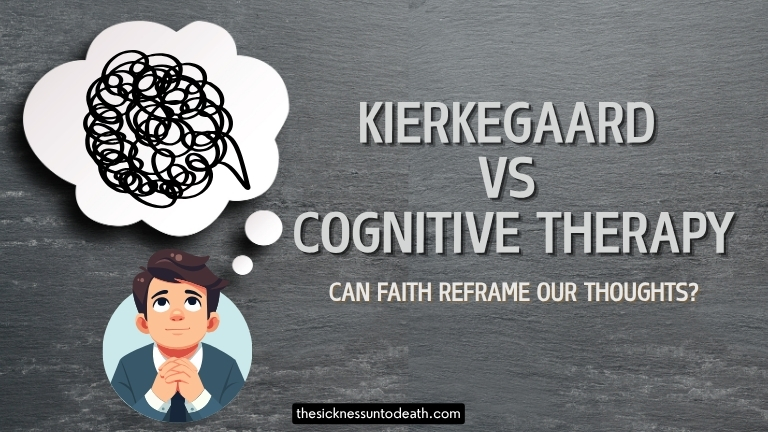
Cognitive behavioural therapy — or CBT — has become a go-to approach for dealing with anxiety, depression, and the general overwhelm of modern life. It gives people practical tools: notice the negative thought, challenge it, replace it with something more balanced. And it often works.
But if Søren Kierkegaard were alive today, he might pause and ask: Is changing our thoughts enough? Or are we missing something deeper — something about the soul, not just the mind?
Therapy Helps — But It Doesn’t Always Go Far Enough
CBT is grounded in the idea that our thoughts shape our emotions, which shape our behaviours. That’s true, and many people find relief using this approach. But it’s also limited.
Because not all pain is about distorted thinking. Sometimes, we’re not struggling with “irrational beliefs” — we’re struggling with meaning. With questions like: Why am I here? Who am I really? Why does life feel so empty, even when I’m doing all the right things?
That’s where Kierkegaard comes in.
Kierkegaard Wasn’t a Therapist — But He Understood Despair
Kierkegaard lived in the 1800s, long before psychology as we know it existed. But his writing — especially in The Sickness Unto Death — dives straight into what we’d now call a mental health crisis.
Only he didn’t call it anxiety or depression. He called it despair — the experience of being out of sync with yourself. Of living a life that looks fine on the outside, but feels empty inside.
And unlike CBT, which aims to manage or eliminate symptoms, Kierkegaard saw despair as something that can actually point us toward truth. Not something to get rid of, but something to learn from.
Reframing Thoughts vs. Reframing the Self
CBT encourages us to challenge thoughts like “I’m a failure” or “No one likes me” and replace them with something more rational. And often, that helps. But Kierkegaard would say: What if you’re asking the wrong question entirely?
Instead of just asking What am I thinking? he asks:
Who am I becoming?
Am I living in truth — or just surviving?
Is my life aligned with who I’m really meant to be?
These are deeper, harder questions. But they might just be the ones that matter most.
Therapy and Faith Aren’t Opposites
This isn’t about choosing between faith or therapy. It’s about seeing how they can work together. CBT can calm the mind. Kierkegaard can stir the soul.
You can learn to manage your thoughts — and take a serious look at your inner life.
You can use CBT techniques — and reflect on whether your life is actually pointing toward something bigger, something eternal.
When Changing Your Thoughts Isn’t Enough
Sometimes, you can reframe every thought in the book and still feel lost. Still feel like something’s off. That’s when Kierkegaard’s idea of despair hits home — because it speaks to a different kind of ache. Not one that comes from thinking wrongly, but from living halfway. From ignoring the quiet voice inside that says: This isn’t it.
And maybe that voice isn’t there to ruin your peace. Maybe it’s there to guide you back to it.
💡 Feeling like there’s more to life than positive thinking? Kierkegaard’s writing might be the next step. Explore these ideas in The Sickness Unto Death: A Modern Translation for the 21st Century