
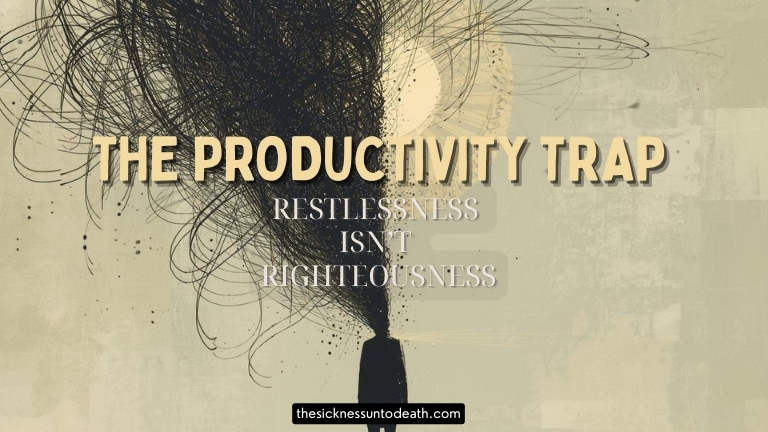
Are we truly growing — or just keeping busy?
In today’s world, being busy feels like a moral good. We measure our days by how much we’ve done, and we wear exhaustion like a badge of honour. If you’re not hustling, you’re falling behind — or so we’re told.
But Søren Kierkegaard, the Danish thinker who spent his life exploring the human spirit, might gently suggest we’ve got it backwards. In The Sickness Unto Death, he speaks of a deeper kind of illness — not of the body, but of the self. And it often shows up in the form of constant motion.
Mistaking Movement for Meaning
It’s easy to fall into the trap of thinking that doing more equals living well. We race through our schedules, ticking off tasks, hoping that productivity will lead to purpose.
But Kierkegaard warns us: activity can become a way of avoiding ourselves. A way of drowning out the quiet questions that might arise if we ever truly stopped.
Questions like:
Who am I really becoming?
What am I moving toward?
And — why am I afraid to slow down?
When Hustle Becomes a Hiding Place
Hustle culture promises fulfilment through effort. But Kierkegaard sees a different kind of life — one grounded not in achievement, but in authenticity.
He argues that real growth happens not through constant doing, but through inwardness: the practice of facing ourselves honestly, before God. That takes time. And often, stillness.
The trouble is, rest can feel threatening when we’ve built our identity on performance. It exposes the gap between what we do and who we are.
The Courage to Be Still
Kierkegaard isn’t calling for passivity or laziness. He’s asking us to consider that perhaps the most courageous thing in a restless world is to be still.
To step off the treadmill of doing.
To sit with uncomfortable questions.
To ask whether our pace is serving our purpose — or just numbing our discomfort.
Because if we never stop, how can we know whether we’re living faithfully or just frantically?
Becoming Takes Time
True selfhood isn’t something you can schedule or hack. It unfolds slowly — through solitude, silence, and spiritual reflection.
Kierkegaard believed that we are each called to become a self in relationship with God. That kind of becoming takes more than effort. It takes depth.
And it begins when we stop measuring our worth by output and start listening for something eternal.
💡 Feeling stretched thin, but still unsure what it’s all for?
👉 The Sickness Unto Death: A Modern Translation for the 21st Century
offers a powerful reminder: you are more than what you do. There is a deeper you, waiting to be remembered.