
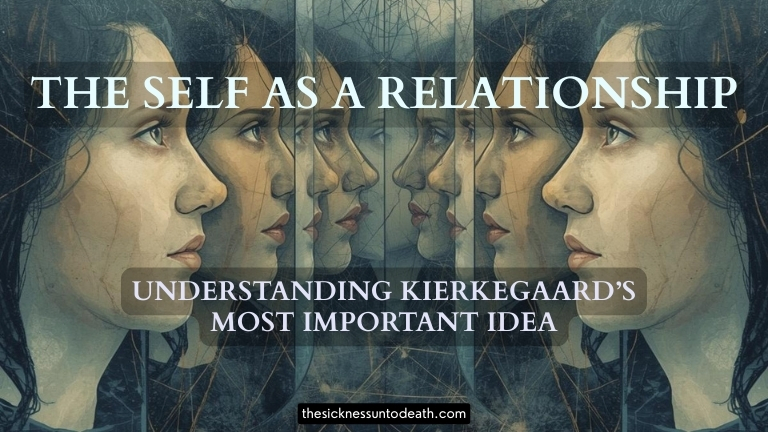
You are not simply a personality, a job title, or a collection of habits. According to Kierkegaard, you are something far more profound.
When people talk about identity today, they often refer to personality types, career paths, or social roles. We ask questions like: What do you do? What are you like? Where do you belong?
But Søren Kierkegaard, the Danish philosopher behind The Sickness Unto Death, proposed a very different understanding of the self. In his view, the self is not a fixed object or a label we carry.
Instead, the self is a relationship.
It’s a dynamic, living connection — a relationship between different parts of who we are, and ultimately a relationship with God.
The Self Is Not a Thing
Kierkegaard famously wrote that “the self is a relation that relates itself to itself.” At first glance, this might sound confusing. But his point is surprisingly practical.
We are not simply bodies moving through the world. Nor are we purely spiritual beings detached from everyday life. Instead, we exist in the tension between the two.
We are both finite and infinite.
We are both limited and full of possibilities.
We live in time, yet we long for eternity.
The self emerges in the relationship between these dimensions.
When this relationship is balanced and grounded, we experience a sense of wholeness. But when it breaks down — when we lose sight of who we are meant to be — despair begins to appear.
Why This Idea Matters
In modern culture, we often treat identity as something we construct ourselves. We build personal brands, curate our online presence, and reinvent our lives whenever we feel dissatisfied.
But Kierkegaard warns that the self cannot simply be manufactured. If we try to invent ourselves without grounding, we risk becoming fragmented.
The self isn’t something we create from nothing. It’s something we must learn to relate to honestly.
That means acknowledging both our limitations and our potential — our weaknesses as well as our calling.
When the Relationship Breaks Down
In The Sickness Unto Death, Kierkegaard describes despair as a problem in this relationship within the self.
Sometimes despair looks like not wanting to be yourself — wishing you were someone else entirely. Other times it appears as refusing to become yourself — avoiding the responsibility of living truthfully.
Both forms of despair emerge when the self loses its proper grounding.
According to Kierkegaard, the self finds its true balance only when it recognises its dependence on God. Without that grounding, we drift between insecurity and self-assertion, never quite at peace.
Learning to Stand Before Yourself
At this point, Kierkegaard’s ideas move beyond abstract philosophy and into something deeply human. In his view, becoming a self is not just about understanding your thoughts or personality — it’s about learning to face your own life truthfully.
The self becomes whole when a person is willing to stand honestly before themselves.
This doesn’t require perfection or total certainty. It simply means acknowledging both who we are now and who we might be capable of becoming.
Through that honest self-reflection, the tensions we all carry — between weakness and possibility, between the life we have and the life we imagine — slowly begin to find their balance.
Becoming, Not Arriving
Perhaps the most encouraging part of Kierkegaard’s idea is that the self is always in the process of becoming. No one has fully arrived. Identity isn’t a finished project.
Instead, life is a journey of learning to relate to ourselves more truthfully — and to the One who created us.
When we begin to see the self this way, identity stops being a performance and becomes a calling.
If you want to explore this powerful idea more deeply, Kierkegaard’s writings remain incredibly relevant today.
👉 Don’t forget to check out The Sickness Unto Death: A Modern Translation for the 21st Century at www.thesicknessuntodeath.com.