
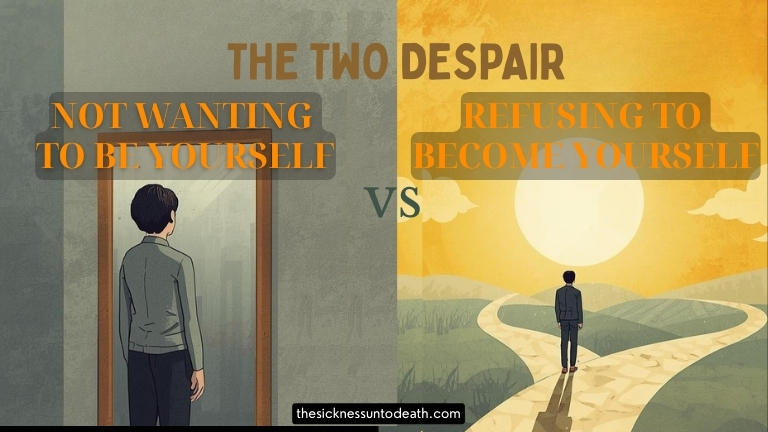
Sometimes the deepest struggle isn’t with the world — it’s with who we are.
There’s a quiet tension many of us carry. A feeling that we’re not quite comfortable in our own skin. At times, we wish we were someone else — more confident, more successful, less anxious, less flawed. Other times, we avoid stepping into who we could become because it feels too demanding, too exposing, too costly.
Nearly two centuries ago, Søren Kierkegaard described this inner conflict with startling clarity. In The Sickness Unto Death, he explains that despair isn’t simply sadness. It’s a misrelation within the self — a refusal to live truthfully as the person we are meant to be.
And at the heart of this misrelation are two forms of despair:
- Not wanting to be yourself.
- Refusing to become yourself.
They sound similar. They are not.
Despair Type One: Not Wanting to Be Yourself
This is the despair of self-rejection.
It’s the quiet thought:
If only I were different.
If only I had their life.
If only I didn’t carry these weaknesses.
It’s a comparison. Shame. Envy. The feeling that your personality, your story, your limits are somehow inadequate.
In modern life, this despair is amplified daily. Social media shows us filtered versions of other people’s lives. Career culture rewards certain traits and sidelines others. We’re subtly taught that who we are isn’t quite enough.
Kierkegaard saw this clearly: when we refuse to accept ourselves as we are — as finite, imperfect, yet uniquely created beings — we drift into despair. Not dramatic despair, but a slow erosion of identity.
It’s exhausting trying to escape yourself.
Despair Type Two: Refusing to Become Yourself
The second despair is subtler — and in some ways more dangerous.
Here, the problem isn’t self-hatred. It’s avoidance.
You know there’s more in you. You sense a calling. A responsibility. A deeper version of yourself is waiting to emerge. But stepping into that person would require courage. Change. Commitment.
So you delay. You distract yourself. You stay comfortable.
Kierkegaard describes this as the despair of defiance — the refusal to align your life with the deeper truth of who you are before God.
It’s easier to drift than to decide. Easier to remain potential than to become actual.
The Self Is a Task
One of Kierkegaard’s most powerful insights is this: the self is not a static object. It’s a relationship — and it’s a task.
We are not meant to invent ourselves from scratch. Nor are we meant to passively accept whatever circumstances hand us. Instead, we are called to become ourselves in relationship with God.
That means embracing both our limits and our responsibilities. Accepting who we are, while courageously growing into who we are meant to be.
This is not self-improvement in the modern sense. It’s something deeper. More demanding. More sacred.
Why This Matters Today
In a world obsessed with reinvention, branding, and endless optimisation, we are tempted toward both despair at once.
We don’t want to be ourselves — because we don’t measure up.
And we don’t want to become ourselves — because that would require real change.
Kierkegaard offers a third way: reconciliation.
Accept the self you’ve been given.
Commit to the self you are called to become.
Do both before God, not before the crowd.
That’s where freedom begins.
From Despair to Wholeness
The good news in The Sickness Unto Death is that despair is not the end. It is a signal. A spiritual diagnosis. A wake-up call.
Once we recognise which despair we are living in, we can begin the journey out of it. Not by pretending to be someone else. Not by forcing ourselves into a new identity. But by honestly relating to ourselves as we are, and surrendering that self to something greater.
Becoming yourself isn’t about perfection. It’s about alignment.
If these ideas resonate — if you’ve ever felt torn between self-rejection and self-avoidance — then Kierkegaard’s insights may speak directly to you.
👉 Check out The Sickness Unto Death: A Modern Translation for the 21st Century at www.thesicknessuntodeath.com — a powerful and accessible guide to understanding despair, identity, and the journey toward authentic selfhood.