
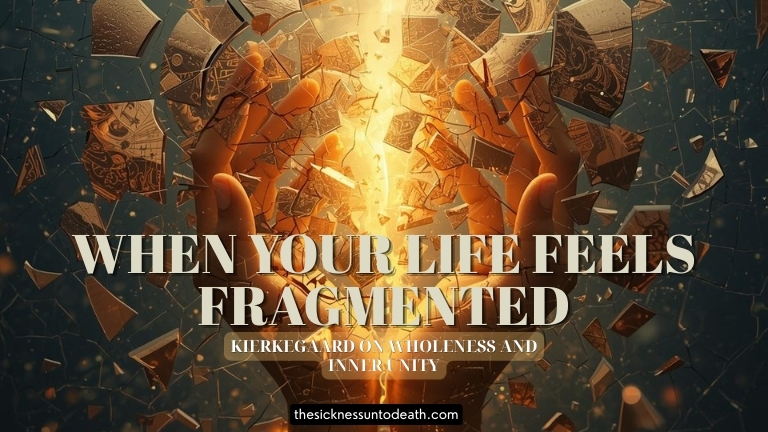
What happens when the different parts of your life no longer seem to fit together?
Many people today live with a quiet sense of fragmentation. One version of us exists at work. Another appears online. Yet another shows up with family or friends. We shift between these roles so often that it can start to feel as if we are several different people rather than one coherent self.
On the surface, everything might still function normally. Responsibilities are met. The routine continues. But inwardly, there is a sense that something is scattered or divided.
Søren Kierkegaard, writing in the nineteenth century, explored this very experience in The Sickness Unto Death. For him, the deepest struggles of human life are not always visible from the outside. They occur within the self — when the different parts of who we are fall out of alignment.
The Problem of a Divided Self
Kierkegaard believed the self is not a simple or static thing. Instead, it is a relationship between different dimensions of our existence. We live between our limitations and our possibilities, between everyday responsibilities and deeper longings.
When these elements are balanced, we experience a sense of inner unity. Life may still be difficult, but it feels coherent.
But when the relationship breaks down, the self becomes divided. One part of us pulls in one direction, another part in another. We may pursue achievements that do not reflect who we truly are. Or we may hide certain parts of ourselves to fit expectations.
This fragmentation can lead to a quiet form of despair — not always dramatic, but deeply unsettling.
Modern Life and the Fragmented Identity
In many ways, modern culture encourages this divided way of living.
We are expected to maintain a professional identity, a social identity, and often an online identity as well. Each context asks us to present a slightly different version of ourselves.
Over time, it can become difficult to know which version is real.
Kierkegaard would argue that this kind of fragmentation happens when we lose sight of the deeper task of becoming a self. Instead of living from an inner centre, we react to external pressures — expectations, comparisons, and social approval.
The result is a life that feels busy but strangely disconnected.
The Search for Inner Unity
For Kierkegaard, wholeness does not come from eliminating our struggles. It comes from bringing the different parts of our lives into an honest relationship with one another.
This requires inward reflection. It means asking difficult questions about how we are living.
Are our actions aligned with our deeper values?
Are we living according to who we truly are, or simply responding to the expectations around us?
Are we willing to face ourselves honestly?
Inner unity begins when we stop performing different versions of ourselves and start living more truthfully.
Becoming Whole
Kierkegaard did not believe that becoming whole happens overnight. It is a gradual process of learning to live with greater awareness and integrity.
It involves accepting our limitations while also recognising our potential. It requires courage to acknowledge where our lives have become fragmented and to begin bringing those pieces back together.
Wholeness, in this sense, is not perfection. It is coherence — a life where who we are inwardly and how we live outwardly begin to align.
A Timeless Insight
Although Kierkegaard wrote nearly two hundred years ago, his insights feel remarkably relevant today. In a world full of noise, expectations, and constant comparison, the challenge of living as a unified self remains as urgent as ever.
When life feels scattered or divided, it may not simply be stress or exhaustion. It may be a sign that something deeper within the self is asking to be rediscovered.
And that rediscovery begins with the courage to look inward.
If you would like to explore Kierkegaard’s ideas about the self, despair, and the journey toward wholeness,
👉 Don’t forget to check out The Sickness Unto Death: A Modern Translation for the 21st Century at www.thesicknessuntodeath.com.