
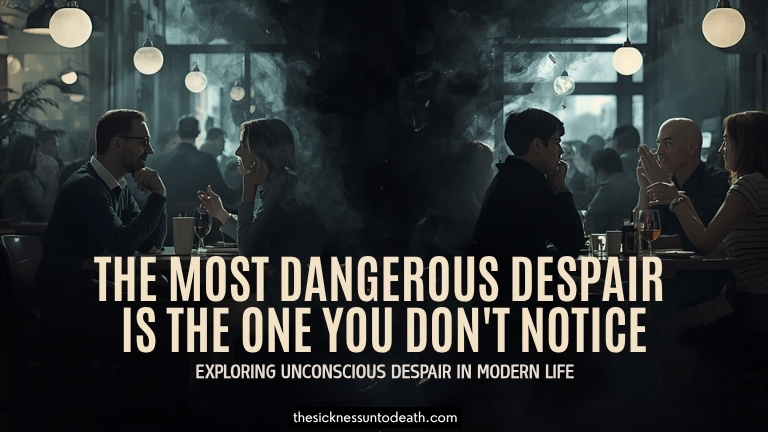
When people think of despair, they often imagine something obvious: overwhelming sadness, emotional breakdowns, or a sense of hopelessness that is impossible to ignore. Yet the most dangerous form of despair is often the one that goes unnoticed.
It hides beneath busy schedules, career ambitions, social media updates, and everyday routines. It doesn’t always announce itself through tears or suffering. Instead, it quietly shapes the way we live, influencing our choices without us ever realising it.
This hidden form of despair is more common in modern life than many people would like to admit.
What Is Unconscious Despair?
Unconscious despair occurs when a person becomes disconnected from their true self without recognising it. On the surface, everything may appear perfectly normal. They go to work, maintain relationships, pursue goals, and fulfil responsibilities. From the outside, their life may even seem successful.
Yet beneath that appearance lies a subtle unease.
There may be a constant feeling that something is missing, despite achievements and possessions. There may be moments of restlessness that cannot be explained. Some people experience it as chronic distraction, endlessly filling every spare moment with entertainment, work, or social activity to avoid facing deeper questions.
The tragedy is not simply the despair itself. The tragedy is remaining unaware of it.
Why Modern Society Makes It Easy to Ignore
Today’s world provides countless ways to avoid self-reflection.
We are surrounded by notifications, streaming services, social media feeds, and endless opportunities for distraction. Productivity is celebrated, busyness is worn as a badge of honour, and success is often measured by external achievements.
While these things are not inherently harmful, they can make it easier to avoid asking difficult questions:
- Am I living according to my deepest values?
- Do my choices reflect who I truly am?
- Am I becoming the person I want to be?
- What gives my life genuine meaning?
When these questions are ignored for long enough, unconscious despair can take root.
A person may spend years pursuing goals that were never truly their own, only to discover that success has not brought the fulfilment they expected.
The Difference Between Sadness and Despair
Sadness is a natural human emotion. It often has a clear cause and can eventually pass.
Despair is different.
Despair concerns the relationship we have with ourselves. It emerges when there is a disconnect between who we are and who we are meant to become. It is possible to feel sad without despairing, and it is equally possible to be outwardly happy while living in despair.
This distinction is particularly important because many people assume that if they are functioning well, they must be doing well internally. Yet emotional comfort is not always a reliable indicator of genuine wellbeing.
Sometimes the deepest struggles remain hidden beneath a perfectly ordinary life.
Signs You May Be Experiencing Unconscious Despair
Because unconscious despair is difficult to recognise, it often reveals itself indirectly.
Some common signs include:
Persistent Restlessness
You constantly seek the next achievement, purchase, relationship, or experience, believing fulfilment lies just beyond your current circumstances.
Fear of Being Alone With Your Thoughts
Silence feels uncomfortable. Every moment must be filled with stimulation, entertainment, or activity.
Living for External Validation
Your sense of worth depends heavily on the approval of others, whether through professional success, social status, or online recognition.
Feeling Disconnected From Purpose
Life feels repetitive or empty, even when things appear to be going well.
Avoiding Deeper Questions
Thoughts about meaning, identity, mortality, or purpose are pushed aside because they feel unsettling or inconvenient.
These experiences do not automatically indicate despair, but they may point towards a deeper issue that deserves attention.
Why Awareness Matters
The first step towards overcoming unconscious despair is recognising it.
Awareness creates the possibility of change. Once we become conscious of the gap between our outward lives and our inner selves, we can begin the difficult but rewarding process of aligning the two.
This often requires honesty, courage, and a willingness to confront uncomfortable truths. It may involve re-evaluating priorities, relationships, ambitions, and beliefs.
Although this process can be challenging, it offers something far more valuable than temporary comfort: authenticity.
A Timeless Insight for the Modern World
The concept of unconscious despair was explored with remarkable depth by Danish philosopher and theologian Søren Kierkegaard. His work remains surprisingly relevant in an age dominated by distraction, consumerism, and constant connectivity.
For modern readers seeking to understand these ideas in accessible language, The Sickness Unto Death: A Modern Translation for the 21st Century offers a fresh interpretation of Kierkegaard’s profound exploration of selfhood, despair, and authentic living.
The book helps bridge the gap between a nineteenth-century philosophical masterpiece and the challenges faced by people today. Whether you are interested in philosophy, psychology, spirituality, or personal growth, it provides valuable insights into one of humanity’s most enduring struggles.
To learn more, visit www.thesicknessuntodeath.com and discover how Kierkegaard’s insights continue to illuminate the hidden forms of despair that shape modern life.
Final Thoughts
The most dangerous despair is not the despair that leaves us visibly broken. It is the despair that quietly accompanies us through everyday life while remaining undetected.
It allows us to drift through the years without questioning who we are, what we value, or why we live as we do.
The good news is that once despair becomes visible, it loses some of its power. Awareness opens the door to authenticity, purpose, and genuine self-understanding.
Perhaps the most important question is not whether despair exists in our lives, but whether we have the courage to recognise it.