
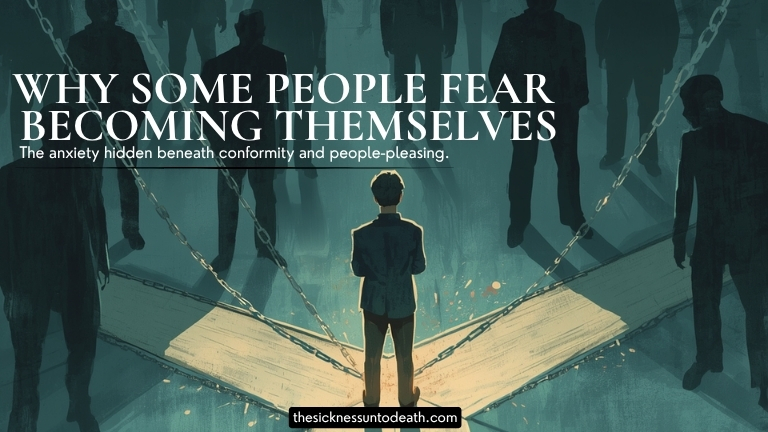
Have you ever wondered why some people seem unable to say what they really think, pursue what they truly want, or show who they genuinely are?
On the surface, it may look like simple insecurity. Yet beneath conformity, perfectionism, and chronic people-pleasing often lies something deeper: a fear of becoming oneself.
This fear is more common than many realise. In a culture that constantly rewards fitting in, standing out can feel surprisingly dangerous.
The Comfort of Conformity
From childhood, we learn that approval matters. We receive praise for following rules, meeting expectations, and behaving in ways others find acceptable.
There is nothing inherently wrong with this. Society depends on cooperation. However, problems arise when external approval becomes the foundation of our identity.
Many people become so accustomed to meeting the expectations of parents, teachers, employers, friends, or society that they lose touch with their own desires. They become experts at adapting to others while remaining strangers to themselves.
Conformity provides a sense of safety. If everyone approves of you, rejection seems less likely. But the cost can be significant.
The more a person shapes themselves around the expectations of others, the further they drift from their authentic self.
Why Authenticity Feels Threatening
Being yourself sounds simple in theory. In reality, it often involves risk.
When you reveal your genuine beliefs, ambitions, preferences, or vulnerabilities, you expose yourself to judgement. People may disagree with you. Some may reject you altogether.
For those who have built their identity around acceptance, this possibility can feel terrifying.
Authenticity removes the protective mask. Suddenly, success and failure become personal. If people reject the real you, it feels far more painful than rejecting a carefully constructed persona.
As a result, many choose the safety of conformity over the uncertainty of self-expression.
The Hidden Anxiety of People-Pleasing
People-pleasing is often mistaken for kindness.
While genuine consideration for others is healthy, chronic people-pleasing frequently stems from anxiety. The people-pleaser becomes preoccupied with maintaining harmony, avoiding conflict, and ensuring everyone else remains comfortable.
The underlying message is often:
“If everyone is happy with me, I will be safe.”
Unfortunately, this strategy rarely creates lasting peace.
Instead, it produces exhaustion, resentment, and a growing sense of emptiness. The person becomes disconnected from their own needs because they are constantly prioritising the needs of others.
Over time, they may struggle to answer a simple question:
“What do I actually want?”
The Fear of Responsibility
Another reason people fear becoming themselves is that authenticity brings responsibility.
When you stop blaming expectations, traditions, or social pressure for your choices, you must confront the reality that your life belongs to you.
That freedom can be unsettling.
If you pursue your genuine ambitions and fail, there is no convenient excuse. If you choose a different path from those around you, you must live with uncertainty and criticism.
Many people unconsciously avoid authenticity because it requires courage. Remaining within familiar expectations can feel safer than embracing the responsibility of selfhood.
The Cost of Avoiding Yourself
The consequences of self-avoidance are often subtle at first.
A person may appear successful, well-liked, and socially adjusted. Yet internally they experience a persistent sense that something is missing.
This feeling can manifest as anxiety, dissatisfaction, boredom, or a vague sense of meaninglessness.
The problem is not necessarily external circumstances. The deeper issue is the growing gap between who a person truly is and who they present to the world.
The wider that gap becomes, the harder it is to feel whole.
Becoming Yourself Is a Lifelong Process
Authenticity is not about discovering a perfect, fixed identity.
It is an ongoing process of honesty, reflection, and courage.
It involves asking difficult questions:
- What do I genuinely value?
- Which beliefs are truly mine?
- What am I doing merely to gain approval?
- Where am I hiding behind conformity?
The answers are not always comfortable. Yet they create the possibility of living with greater integrity and purpose.
Becoming yourself may involve disappointment, rejection, and uncertainty. But it also opens the door to something many people spend their lives searching for: a sense of inner coherence.
Final Thoughts
The fear of becoming oneself is rarely discussed openly because it often disguises itself as responsibility, politeness, ambition, or social adjustment.
Yet beneath these behaviours can lie a profound anxiety about authenticity.
The paradox is that the more we avoid ourselves, the more disconnected and dissatisfied we tend to become. Genuine fulfilment begins when we stop living solely according to external expectations and start taking ownership of who we are.
The journey is not easy, but it may be one of the most important journeys a person ever undertakes.
For readers interested in exploring these themes of identity, despair, authenticity, and selfhood in greater depth, The Sickness Unto Death: A Modern Translation for the 21st Century offers valuable insights. Learn more at The Sickness Unto Death.