
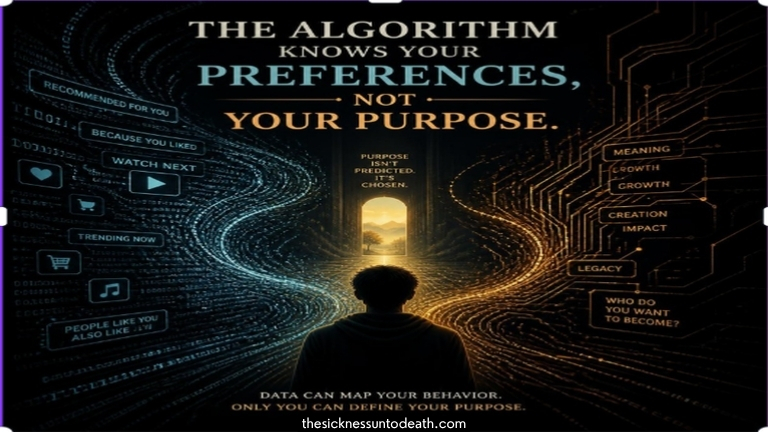
Every day, algorithms learn a little more about us.
They know which videos we watch until the end, what products tempt us to click, the songs we replay, and even the time of day we’re most likely to buy something. They’re remarkably good at predicting our preferences.
But there’s one thing they can’t discover.
Your purpose.
Desire Is Easy to Track
Modern technology thrives on desire.
The more you interact with content, the more accurately platforms can feed you what you already want. It’s a loop designed for engagement. You watch one cooking video, and suddenly your feed is full of recipes. Browse hiking boots once, and advertisements follow you for weeks.
Desire leaves a digital footprint.
Purpose doesn’t.
Your deepest calling isn’t revealed by your search history or your scrolling habits. In fact, purpose often asks you to move in directions that your immediate desires would never choose.
The Difference Between Desire and Calling
Desire usually asks:
- What do I want right now?
- What feels good?
- What makes life easier?
- What gives me pleasure?
Calling asks something very different.
- Who am I becoming?
- What am I here to contribute?
- What is worth sacrificing for?
- What kind of life is truly meaningful?
Desire seeks comfort.
Calling often requires courage.
Desire changes with our mood. Calling remains, even when enthusiasm fades.
Why Algorithms Keep Us Comfortable
Algorithms aren’t evil. They’re simply doing what they were designed to do.
Their job is to maximise attention.
The more accurately they predict your preferences, the longer you’ll stay engaged.
The problem is that growth rarely begins with what we already prefer.
Some of life’s most important decisions don’t feel immediately attractive.
Forgiving someone.
Starting a difficult conversation.
Changing careers.
Becoming a parent.
Serving others.
Standing by your principles.
None of these choices is obvious from your online behaviour.
Purpose Often Interrupts Preference
Many people assume purpose should feel exciting all the time.
It usually doesn’t.
Sometimes, calling appears as an uncomfortable responsibility that refuses to leave you alone.
It asks you to become someone different rather than simply consume something different.
That’s why purpose cannot be personalised in the same way entertainment can.
An algorithm can recommend another film you’ll probably enjoy.
It cannot tell you how to become a person of integrity.
The Danger of Living by Preference Alone
When life becomes entirely preference-driven, we risk confusing convenience with fulfilment.
We choose what is easiest.
We avoid discomfort.
We chase endless novelty.
Yet many people who have everything they once desired still find themselves asking a deeper question:
“Is this all there is?”
This isn’t a technological problem.
It’s a human one.
The more our lives revolve around satisfying immediate desires, the easier it becomes to ignore the quieter voice of purpose.
Listening Beyond the Feed
Finding your calling rarely happens through endless scrolling.
It often requires silence.
Reflection.
Honest self-examination.
It means asking questions that no recommendation engine can answer.
What kind of person am I becoming?
What responsibilities have I been avoiding?
What truth have I been distracting myself from?
These questions aren’t popular because they don’t promise instant gratification.
They invite transformation instead.
A More Meaningful Way Forward
Technology is an extraordinary tool, but it should never become our compass.
Use algorithms for discovering music, books, recipes, or travel ideas.
Don’t ask them to define your identity.
Your preferences matter.
But your purpose matters far more.
The challenge isn’t escaping technology.
It’s refusing to let your deepest values be shaped by systems designed only to maximise your attention.
At some point, every person must decide whether they will simply become the sum of their preferences or pursue a calling that asks something greater of them.
That decision has never belonged to an algorithm.
Continue the Conversation
If these ideas resonate with you, you’ll find a deeper exploration of purpose, despair, identity, and what it means to become your true self in The Sickness Unto Death: A Modern Translation for the 21st Century.
Discover more and order your copy at www.thesicknessuntodeath.com.