
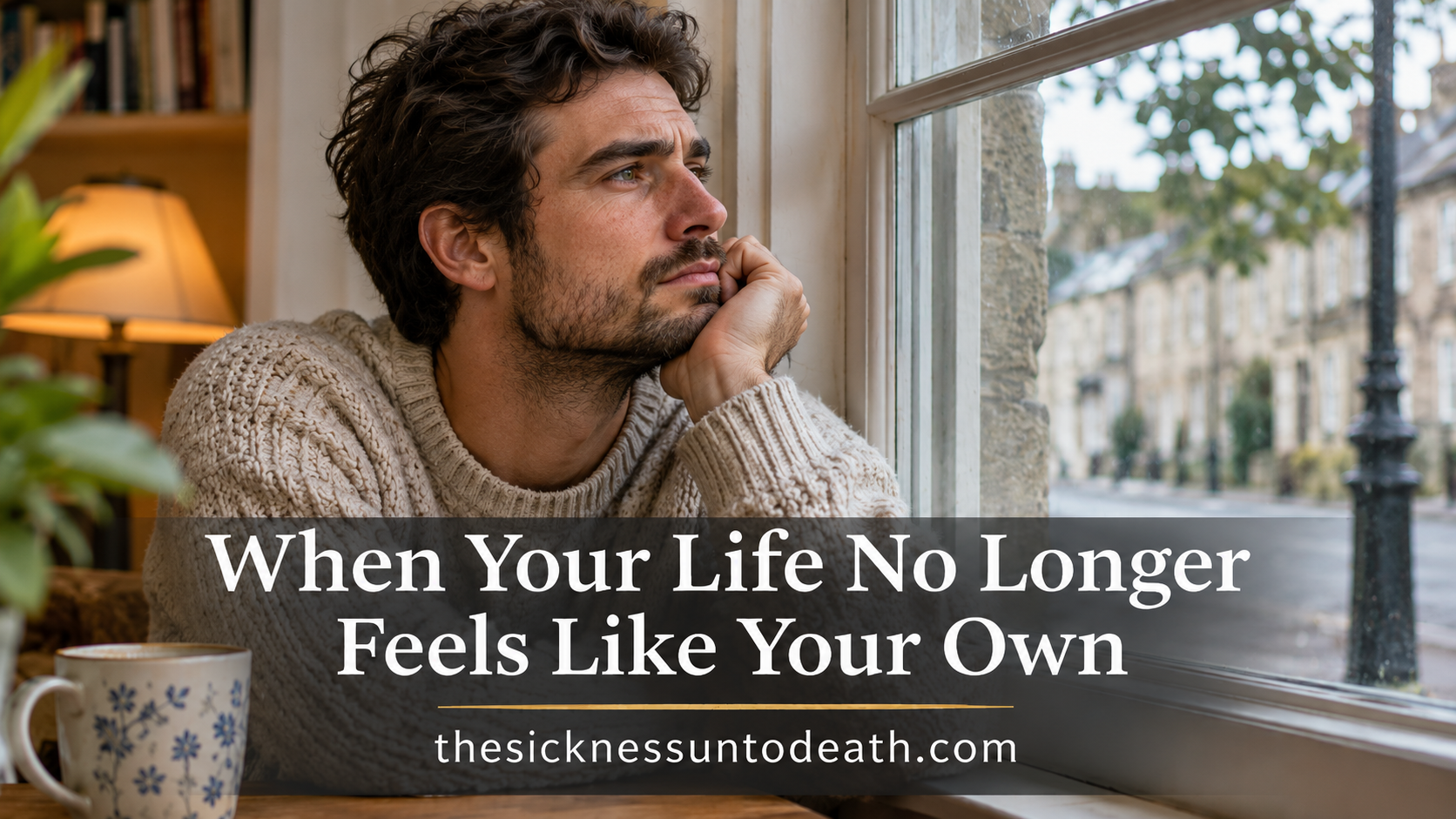
Have you ever looked at your life and wondered how you ended up here?
Not because anything terrible has happened.
In fact, from the outside, things might look perfectly fine.
You have responsibilities. People who depend on you. A routine that keeps everything moving.
You wake up, go to work, answer messages, make decisions, sort things out, and get through another day.
Then you do it all again.
And somewhere in the middle of it, you begin to feel as though you’re living a life that doesn’t quite belong to you.
It’s difficult to explain.
You’re not necessarily unhappy. You’re not desperate to change everything.
But there’s a quiet feeling that something is missing.
And perhaps the strangest part is that you can’t quite remember when it started.
When Your Days Become a Series of Obligations
Most of us don’t wake up one morning and decide to stop living for ourselves.
It happens gradually.
You take on a little more responsibility at work.
You agree to something because you don’t want to disappoint anyone.
You put off something you’ve always wanted to do because there are more important things to deal with.
And of course, some of those things really are important.
There’s nothing wrong with caring for others, working hard, or making sacrifices.
But when every day becomes about what needs to be done, it’s easy to forget what you actually want.
You become very good at meeting expectations.
You know what your family needs.
You know what your employer expects.
You know what everyone else is waiting for.
But when someone asks what you want, you hesitate.
Because you haven’t really thought about it for a while.
The Strange Feeling of Being a Stranger to Yourself
Sometimes, losing touch with yourself doesn’t look dramatic.
It looks like saying, “I’m fine,” when you’re not entirely sure how you feel.
It looks like going along with plans you wouldn’t have chosen.
Or spending your free time doing things you don’t particularly enjoy, simply because they’ve become habits.
You might even catch yourself wondering whether the person you are today is the person you once imagined becoming.
Perhaps you used to be more adventurous.
Perhaps you had creative interests, ambitions, or little things that made you feel excited about life.
Now, those parts of yourself seem distant.
You haven’t necessarily lost them.
You just haven’t had much room for them lately.
And the longer this continues, the easier it becomes to believe that this is simply who you are now.
Are You Living Your Life or Someone Else's Expectations?
Think about how many decisions we make because of what other people might think.
We choose careers that sound respectable.
We stay in situations because leaving would be inconvenient.
We follow familiar paths because they’re easier to explain.
And sometimes, without realising it, we build entire lives around expectations we never consciously agreed to.
That doesn’t mean every decision you’ve made was wrong.
You may genuinely love your family, value your work, and appreciate the life you’ve built.
But it’s still worth asking:
How much of this life have I chosen, and how much have I simply accepted?
It’s not always an easy question.
Because the answer might reveal that you’ve spent years being the person you thought you were supposed to be.
Rather than discovering who you actually want to become.
What Kierkegaard Understood About Losing Yourself
More than a century ago, Danish philosopher Søren Kierkegaard explored a surprisingly familiar problem.
In his work The Sickness Unto Death, he examined what happens when people become disconnected from their true selves.
For Kierkegaard, despair wasn’t always about obvious sadness or suffering.
Sometimes, it involved something much quieter.
A person could appear successful, maintain relationships, fulfil responsibilities, and continue with everyday life while remaining unaware of a deeper struggle with their own identity.
One of the ideas at the heart of his philosophy is that we can lose ourselves by becoming too absorbed in the expectations and distractions of the world around us.
We become what others expect.
We follow what seems normal.
We keep ourselves busy.
And in doing so, we may avoid confronting the deeper question of who we really are.
Kierkegaard’s understanding of the self was also deeply connected to faith and our relationship with God. For him, becoming ourselves wasn’t simply about personal freedom or doing whatever we pleased. It involved honestly recognising who we are and the foundations of our existence.
Even today, his reflections can encourage us to examine the difference between merely getting through life and living with a deeper sense of self.
Because sometimes the problem isn’t that our lives are falling apart.
It’s that we’ve become disconnected from the person living them.
You Don't Have to Change Everything to Find Yourself Again
When you realise something feels wrong, it’s tempting to imagine that you need a completely different life.
A new job.
A different home.
A fresh start somewhere far away.
And perhaps, for some people, significant changes really are necessary.
But reconnecting with yourself doesn’t always require a dramatic decision.
Sometimes, it begins with paying attention.
Notice what makes you feel genuinely interested in something.
Think about the activities you keep putting off.
Remember the conversations that leave you feeling energised rather than exhausted.
Ask yourself when you last made a decision simply because it mattered to you.
You might discover that the parts of yourself you’ve been missing haven’t disappeared at all.
They’ve just been buried beneath everything else.
And gradually making room for them can change how you experience your everyday life.
Learning to Say No Without Feeling Guilty
One of the most difficult parts of reclaiming your life is accepting that you cannot meet everyone’s expectations.
There will always be another favour to do.
Another responsibility to take on.
Another person who needs something from you.
And when you’re used to being dependable, saying no can feel uncomfortable.
You might worry that you’re being selfish.
But there’s a difference between caring about other people and constantly placing yourself last.
You can be kind without agreeing to everything.
You can love people without organising your entire life around their preferences.
You can be responsible while still protecting time for the things that matter to you.
Sometimes, a simple “I can’t do that today” is enough.
You don’t always need a long explanation.
And you don’t have to feel guilty for having needs of your own.
It's Okay If You Don't Know What You Want Yet
Here’s something people don’t always talk about.
When you’ve spent years following routines and meeting expectations, figuring out what you want can feel surprisingly difficult.
You might finally get an afternoon to yourself and have absolutely no idea what to do with it.
Or someone might ask what would make you happy, and you genuinely won’t know how to answer.
That’s all right.
You don’t need to suddenly discover a hidden passion or work out your entire future.
Start with smaller questions.
What do you enjoy when nobody is watching?
What would you like to learn, even if you weren’t particularly good at it?
What parts of your day feel meaningful?
What have you stopped doing that you secretly miss?
You may not have clear answers straight away.
But asking these questions is already a way of paying attention to yourself again.
A Life That Feels Like Yours
Perhaps the goal isn’t to build a life that looks completely different.
Perhaps it’s to feel more present in the one you already have.
To make decisions because they reflect your values, rather than simply because they’re expected.
To spend time on things that matter to you.
To recognise when you’re doing something out of love, and when you’re doing it purely out of obligation.
And to accept that you are allowed to change.
The person you were five years ago doesn’t have to determine every choice you make today.
You can reconsider old ambitions.
You can develop new interests.
You can decide that something which once mattered enormously no longer feels right.
Life doesn’t always give us the freedom to change everything.
But even within our responsibilities, there may be small ways to live more deliberately.
And those small choices matter.
Finding Your Way Back to Yourself
If your life no longer feels like your own, it doesn’t necessarily mean you’ve made the wrong choices.
Perhaps you’ve simply been so busy living up to expectations that you’ve forgotten to check whether those expectations still fit.
Perhaps you’ve changed, but your routines haven’t.
Or perhaps there’s a part of yourself you’ve been ignoring because there never seems to be enough time.
Whatever the reason, you don’t have to solve everything today.
You can begin by being curious about your own life again.
Notice what feels right.
Question what no longer does.
Make room for the things that remind you who you are.
Because your life doesn’t have to be perfect to feel meaningful.
But it should, as much as possible, feel like a life you’re genuinely taking part in.
And sometimes, finding your way back to yourself begins with a very simple question:
Am I living the life I want, or just the life I’ve become used to?
Explore the Deeper Meaning of Selfhood
Why do we sometimes feel disconnected from ourselves, even when everything in life appears to be going well?
In The Sickness Unto Death, Søren Kierkegaard explores the relationship between identity, despair, self-awareness, and what it means to truly become ourselves.
If you’ve ever questioned who you are beneath your responsibilities, expectations, and everyday routines, his reflections offer a deeper philosophical perspective.
Discover The Sickness Unto Death: A Modern Translation for the 21st Century, a modern translation that brings Kierkegaard’s thought-provoking ideas to contemporary readers.
Learn more at www.thesicknessuntodeath.com.