
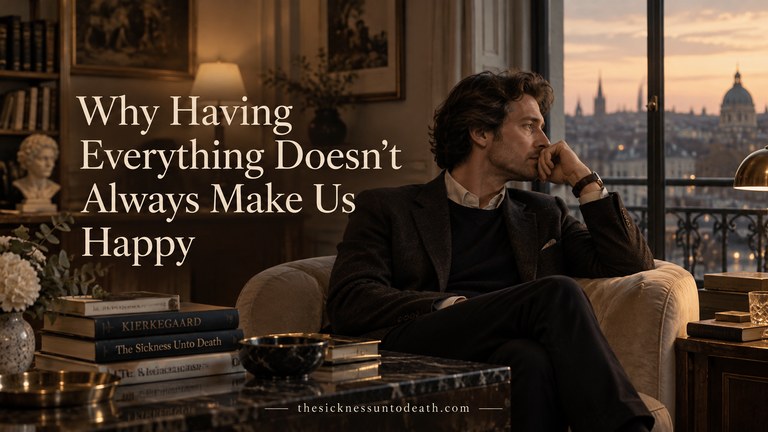
There comes a point in life when you might look around and realise you have many of the things you once wished for.
A comfortable home. A steady income. People who care about you. Perhaps a career you’ve worked hard to build, a family you love, or the freedom to enjoy things that once felt out of reach.
By most standards, life is going well.
And yet, something still feels missing.
It’s a strange feeling, isn’t it?
You tell yourself you should be happy. You remind yourself how fortunate you are. You might even feel guilty for wanting something more when you already have so much.
But the feeling doesn’t always go away.
Why is that?
Perhaps because having everything we want and feeling genuinely fulfilled are not quite the same thing.
This is a question that Danish philosopher Søren Kierkegaard explored long before modern life became filled with endless choices, achievements and expectations.
And his ideas in The Sickness Unto Death remain surprisingly relevant today.
The Happiness We Spend Our Lives Chasing
From an early age, we’re encouraged to work towards certain things.
Study hard. Find a good job. Earn enough money. Build a comfortable life. Achieve something meaningful.
There’s nothing wrong with any of these ambitions.
Financial security matters. Relationships matter. Having a safe place to live and opportunities to enjoy life can make an enormous difference to our wellbeing.
The difficulty begins when we start believing that reaching these milestones will automatically make us happy.
We imagine that once we earn a certain salary, buy a house, or achieve a particular goal, everything will finally fall into place.
And sometimes, reaching those goals does bring genuine happiness.
But often, after the excitement fades, we find ourselves looking towards the next thing.
A better job.
A bigger house.
Another achievement.
Something else to look forward to.
It’s almost as though happiness keeps moving a little further away each time we get close to it.
And we rarely stop to ask whether we’ve been looking for it in the right place.
Why Success Can Still Leave Us Feeling Empty
Imagine spending years working towards a promotion.
You put in the extra hours, make sacrifices and convince yourself that everything will be worth it when you finally reach that position.
Then one day, you get the news.
You’ve done it.
For a while, you feel proud, relieved and excited.
But a few weeks later, life begins to feel ordinary again.
The responsibilities increase. New expectations appear. And somewhere in the middle of it all, you begin wondering why the achievement hasn’t changed how you feel inside.
This doesn’t mean the promotion was meaningless.
It simply means that external success cannot always answer the deeper questions we have about ourselves.
Who am I beyond my job title?
What makes my life meaningful?
Am I living in a way that feels true to who I am?
These are questions that achievements alone cannot settle.
And they’re closely connected to Kierkegaard’s understanding of despair.
What Søren Kierkegaard Can Teach Us About Happiness
In The Sickness Unto Death, Kierkegaard explores despair in a way that goes far beyond what we usually understand it to mean.
Most of us associate despair with sadness, hopelessness or a difficult period in life.
But Kierkegaard suggests that despair can exist even when someone appears perfectly happy.
A person may have wealth, success, friendships and a comfortable life, yet still experience a deeper struggle within themselves.
For Kierkegaard, despair concerns our relationship with who we are.
It emerges when the self is not properly related to itself and, in his Christian understanding, to the God who established it.
This means that despair isn’t always obvious.
It doesn’t necessarily look like someone crying, withdrawing from others or struggling to get through the day.
Sometimes, it can exist beneath a life that looks successful from the outside.
Someone might spend years building an identity around their career, possessions or other people’s approval without ever considering who they are beyond those things.
They may feel satisfied in many ways while remaining unaware of a deeper disconnection.
Kierkegaard’s point is not that success or happiness is bad.
Rather, it’s that a fulfilling outward life does not necessarily mean we have found peace within ourselves.
When We Confuse What We Have With Who We Are
Think about how often we introduce ourselves through what we do.
“I’m a manager.”
“I’m a business owner.”
“I’m a parent.”
“I’m successful.”
“I’m retired.”
These descriptions are useful. They tell people something about our lives.
But they don’t tell the whole story.
Our jobs can change.
Our financial circumstances can change.
Our children grow older.
Our appearance changes.
Even the relationships and routines that shape our daily lives may look very different in ten or twenty years.
So what happens when something we’ve built our identity around disappears?
A person who has always been recognised for professional success might struggle after retirement.
Someone who measures their worth through financial achievements may feel inadequate when their circumstances change.
And someone who constantly seeks approval might find it difficult to make decisions without wondering what everyone else thinks.
Kierkegaard invites us to consider something deeper.
If we build our entire sense of self around things that can change, what remains when those things are taken away?
It’s not an easy question.
But it’s an important one.
Because perhaps part of finding genuine fulfilment involves learning to recognise ourselves beyond our achievements, possessions and social roles.
The Pressure to Be Happy When Life Looks Perfect
There’s another side to this experience that we don’t always talk about.
The guilt.
When you have a comfortable life, admitting that you’re unhappy can feel almost ungrateful.
You might think:
Other people have it much harder than I do.
I have no reason to complain.
Why can’t I just appreciate what I’ve got?
So you keep the feeling to yourself.
You carry on with your routines, fulfil your responsibilities and remind yourself that life could be worse.
And of course, gratitude is valuable.
Recognising the good things in our lives can help us appreciate what we might otherwise overlook.
But gratitude doesn’t mean we have to pretend that every part of our lives feels complete.
We can appreciate what we have while still questioning what gives our lives meaning.
We can love our families and still feel uncertain about our direction.
We can enjoy professional success and still wonder whether we’re becoming the person we want to be.
These feelings don’t automatically make us selfish or ungrateful.
They may simply reveal that something deserves our attention.
Why More Isn't Always the Answer
When something feels missing, our natural instinct is often to look for something new.
We book a holiday.
Buy something we’ve wanted for ages.
Set another goal.
Start planning the next exciting chapter.
And there’s nothing wrong with enjoying these things.
Sometimes, a change of scenery or a new experience is exactly what we need.
But if the deeper problem is that we’ve lost touch with ourselves, constantly adding more to our lives may not resolve it.
We might find ourselves returning from a wonderful holiday only to feel the same restlessness a few days later.
Or buying something we’ve wanted for months and discovering that the excitement doesn’t last as long as we expected.
The problem isn’t necessarily that we haven’t found the right thing yet.
Perhaps we’re expecting external experiences to provide something they were never designed to give us.
Kierkegaard’s philosophy encourages us to consider whether the answer lies not in accumulating more, but in examining how we understand ourselves and our existence.
That doesn’t mean abandoning ambition or giving away everything we own.
It means recognising that a meaningful life cannot be measured entirely by what we’ve achieved or acquired.
Learning to Be Comfortable With Who We Are
One of the most challenging aspects of Kierkegaard’s thinking is his emphasis on becoming oneself.
It sounds simple.
After all, aren’t we already ourselves?
But consider how much of our lives can be shaped by expectations.
We choose careers because they seem respectable.
We pursue goals because society tells us they’re important.
We compare our progress with people our age.
We sometimes make decisions based less on what we genuinely believe and more on what we think we should want.
Over time, it can become difficult to distinguish our own values from the expectations we’ve absorbed.
Kierkegaard’s understanding of becoming oneself is more demanding than simply doing whatever feels right.
It involves honestly confronting who we are, recognising both our limitations and possibilities, and understanding our dependence on God.
In his view, the self cannot find its deepest resolution through achievement or self-sufficiency alone.
That spiritual dimension is central to The Sickness Unto Death.
Even for readers approaching the book from a philosophical rather than religious perspective, its questions about identity, self-deception and authenticity can encourage meaningful reflection.
Perhaps we need to ask ourselves:
- Am I pursuing this goal because it matters to me, or because I want others to admire me?
- Have I become so busy building a successful life that I’ve forgotten to consider what makes it meaningful?
- What parts of my identity would remain if my circumstances changed tomorrow?
- Am I willing to confront the questions I’ve been avoiding?
We may not find immediate answers.
But sometimes, asking the right questions is more valuable than rushing towards the next achievement.
Finding Contentment Without Giving Up Ambition
Does all this mean we should stop striving for success?
Not at all.
There’s nothing inherently wrong with wanting financial stability, professional growth or a more comfortable life.
Ambition can encourage creativity, discipline and meaningful contributions to the world.
The difference lies in how much of our identity we attach to the outcome.
We can work towards a promotion without believing that our worth depends on getting it.
We can enjoy a beautiful home without expecting it to give our lives purpose.
We can celebrate achievements without assuming that success will resolve every uncertainty we have about ourselves.
Perhaps genuine contentment begins when we stop asking our accomplishments to define who we are.
When we can appreciate what we have without constantly needing more to feel valuable.
When we can recognise that life may be meaningful even during periods when we’re not achieving anything particularly impressive.
And when we’re willing to explore the deeper questions that success, possessions and recognition cannot answer.
Kierkegaard would take this further, arguing that the self ultimately finds its proper grounding through its relationship with God.
It’s this movement from an unsettled relationship with oneself towards a rightly grounded self that gives his work its deeper significance.
Maybe Happiness Was Never About Having Everything
It’s easy to imagine happiness as a destination.
A place we’ll eventually reach when enough things have gone right.
When we have the career.
The money.
The relationships.
The security.
The life we once dreamed about.
But perhaps we can have all those things and still feel that something important remains unanswered.
Not because those things are worthless.
But because they’re only part of what it means to be human.
Our lives are not simply collections of accomplishments and possessions.
We are also people searching for meaning, identity, connection and a sense of where we belong.
And sometimes, the questions we avoid when we’re busy achieving things are the very questions that deserve our attention.
Kierkegaard reminds us that despair isn’t always found in a life that appears to be falling apart.
It can also exist in a life that seems to have everything.
Perhaps that’s why The Sickness Unto Death still matters today.
It challenges us to look beyond the surface of our lives and consider whether we truly understand who we are.
Because having everything we once wanted doesn’t necessarily mean we’ve found what we were really looking for.
And perhaps a more meaningful life begins not by asking what else we need to have, but by asking who we are becoming.
Discover The Sickness Unto Death: A Modern Translation for the 21st Century
Why do we sometimes feel unfulfilled even when life seems to be going well? What does it mean to truly become ourselves? And can we experience despair without even realising it?
These are some of the profound questions explored in Søren Kierkegaard’s The Sickness Unto Death.
The Sickness Unto Death: A Modern Translation for the 21st Century brings Kierkegaard’s philosophical and spiritual reflections to contemporary readers, offering an opportunity to explore the relationship between despair, identity, faith and what it means to be human.
If you’ve ever wondered why success doesn’t always bring happiness, or why having everything can still leave you searching for something deeper, this book offers a thought-provoking place to begin.
Discover the book and explore Kierkegaard’s ideas at www.thesicknessuntodeath.com.